
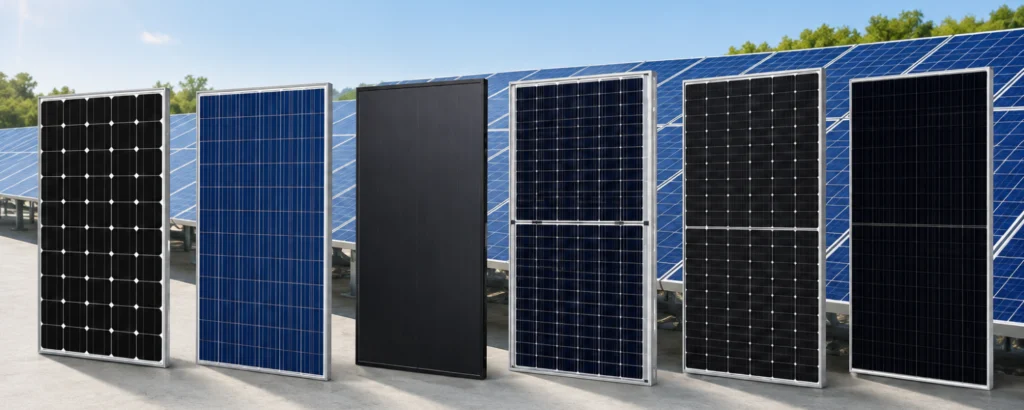
Currently, there are six types of solar panels in India. They include monocrystalline, polycrystalline, thin-film, bifacial, PERC, and N-Type TOPCon panels. Monocrystalline panels have a high efficiency rate and lifespan, while polycrystalline panels are ideal for those on a low-budget. Bifacial and TOPCon panels are relatively new types of panels that are now becoming popular in India. Each type is appropriate for certain roofs, budgets, and energy requirements.
Key Takeaways
-
- There are 6 different types of solar panels in India. They are used for both residential and commercial purposes.
- The monocrystalline panel is the most efficient one and has an efficiency range between 19% to 25%.
- The polycrystalline panels are cheaper but require more roof area than monocrystalline panels.
- The bifacial panels use both sides for producing electricity and increase efficiency by 30%.
- Thin-film solar panels are suitable for big, flexible, or unusual designs.
- PERC technology enhances efficiency because it captures more sunlight from the rear side of the panel.
- N-Type TOPCon panels perform better in terms of heat tolerance in India compared to older P-Type panels.
- It is important to choose panels based on space available, budget, and the lifespan of the system.
- It is equally important to choose a reputable solar manufacturing company in India.
- The choice of an appropriate inverter is important in determining how well the panels perform.
What Are the Different Types of Solar Panels in India?
Solar panels in India have certainly come a long way from the simple blue panels seen on the rooftops. There are various kinds of solar panels available in the market, each having its own purpose. Some of these panels are efficient; some are affordable, while others are flexible. Let’s take a closer look at each type.
1. Monocrystalline Solar Panels
These panels are cut from one pure silicon crystal, which gives them a very smooth black appearance and makes them the most efficient type of panel. They can convert the sun’s rays into electricity at efficiencies ranging from 19% to 25%, and have an average lifespan of 25 to 30 years.
Benefits:
- Most efficient solar panels among all types
- Performs well in the case of a small rooftop space
- Has better heat resistance compared to polycrystalline panels
- Long lifespan due to low degradation
Yes, these panels do cost more upfront and waste some amount of silicon in their production. Still, this type is the best choice for homeowners with limited rooftop space.
2. Polycrystalline Solar Panels
The formation of polycrystalline panels involves melting several silicon fragments. This creates a blue appearance with a speckled surface. Efficiency is relatively low, usually between 14% and 18%, and their lifespan ranges from 20 to 25 years.
Benefits:
- Cheaper than monocrystalline panels
- Easier manufacturing process, with less waste generation
- Dependable performance for solar farms and off-grid installations
They require more area to generate an equivalent amount of energy compared to a monocrystalline panel, and their efficiency is affected more by high temperatures.
3. Thin-Film Solar Panels
The production of thin-film solar panels involves layering photovoltaic materials like cadmium telluride and amorphous silicon on glass, metal, or plastic. The panels are much thinner and lighter than the crystalline type, with an efficiency rate of 11% to 12%, and have a lifespan of 10 to 20 years.
Benefits:
- Lightweight and flexible for unusual surfaces
- Reduced manufacturing cost
- Function well even with little or dispersed light
Because of their lower efficiency and shorter warranties, they are not commonly used in residential projects but are suitable for industrial roofs, transport, and portable setups.
4. Bifacial Solar Panels
Bifacial panels are able to harvest solar energy from both sides. If installed on an inclined surface with a reflecting surface, they will increase the output capacity by 30% compared to conventional single-faced panels. The efficiency of such panels is 22%, with a lifespan of over 25 years.
Benefits:
- Greater energy production per unit area of the roof
- Works well on reflective roofs and open yards
- Longer lifespan and better return on investment
They require specific positioning and cost much more, but for houses with open reflective roofs, it’s usually worth the money spent.
5. PERC Solar Panels
Passivated Emitter and Rear Cells (PERC) technology involves additional rear layers that reflect unabsorbed sunlight into the cell to allow a further round of conversion. This increases their efficiency by 19% to 22%. The PERC technology is usually combined with monocrystalline cells, which are called Mono-PERC half-cut panels and last for more than 25 years.
Benefits:
- More efficient than regular monocrystalline panels
- Perform well in low lighting conditions, like in the early morning or when it is cloudy
- Improved thermal resistance compared to older panel designs
They may be slightly more expensive than normal monocrystalline panels, but they generate more electricity per square foot. Hence, these types of solar panels for houses are more suitable due to limited rooftop spaces.
6. N-Type TOPCon Solar Panels
The tunnel oxide passivated contact, or TOPCon, is an N-type cell structure that has gained significant traction among Indian manufacturers. While P-Type panels like PERC panels use boron-doped silicon, N-Type panels make use of phosphorus-doped silicon. As a result, there is a decrease in the temperature coefficient, which implies that TOPCon panels do not lose power when the temperature rises. This is the best type of solar panel for states like Rajasthan and Telangana.
Benefits:
- Degradation at lower rates, about 0.25% to 0.4% per year
- More efficient in high temperature and humidity conditions
- The bifaciality coefficient is higher with a bifacial panel configuration
- Long-term guarantees, up to 25 years
Despite TOPCon solar cells being more expensive than Mono-PERC per watt, they generally produce enough energy throughout their life cycle to pay off their higher cost.
Comparison of Solar Panel Types in India
| Panel Type | Efficiency | Lifespan | Suited For |
| Monocrystalline | 19% to 25% | 25 to 30 years | Homes with limited roof space |
| Polycrystalline | 14% to 18% | 20 to 25 years | Solar farms, off-grid, budget projects |
| Thin-Film | 11% to 12% | 10 to 20 years | Industrial roofs, portable and flexible use |
| Bifacial | Up to 22% | 25+ years | Reflective rooftops, open yards |
| PERC | 19% to 22% | 25+ years | Compact urban homes need higher output |
| N-Type TOPCon | Up to 23% | 25+ years | Hot climates, commercial rooftops |
Which Is the Best Type of Solar Panel for Houses in India?
In general, the best kind of solar panel for Indian houses depends on three factors: roof size, budget, and weather. In cases where you have limited roof space, monocrystalline and Mono-PERC panels give the highest power density per square meter. For a reflective roof with sunny climate conditions and long-term use in mind, you should go for bifacial or topcon panels. When the roof is large and there is good reflective sunlight on it, then bifacial or TOPCon panels would be a good investment option.
The weather is also an important factor. In areas where the temperature is high, the N-Type TOPCon solar panels will be more advantageous due to their low temperature coefficient.
A Quick Word on Inverters
Choosing the type of panel is just the beginning of your decision-making process. The inverter will turn your panels’ direct current into alternating current that you can use in your house. String inverters are the best solution when your rooftop is without any kind of obstacles and is easy to access. Micro-inverters are pricier but do well in shaded or tilted roofs. A hybrid inverter is an ideal choice for those who wish to store energy in their house through batteries or where there are frequent power failures.
Conclusion
India’s solar technology is ever evolving, and choosing a panel is no longer an easy choice. It is best that you consider factors such as your roof area, budget, and climate in your location before making any decisions. Get a few quotes from different solar panel installers and be sure to look at warranties carefully before taking a call.
FAQs
1. Which is better, N-Type or P-Type solar panels?
N-type panels, including TOPCon panels, tend to work better. They age slowly, cope with heat better, and have longer warranties. P-Type panels like PERC cost less and fit budget residential requirements without higher expectations.
2. Which solar panel is best, bifacial or TOPCon?
It all depends on the type of your project. The use of TOPCon panels will ensure quicker paybacks and easier installations on most homes. Bi-Facial panels will produce more power in large reflective or open installations. The best panels these days will have both technologies.
3. Do bifacial panels need special inverters?
A specific type of inverter is not necessary, but the inverter must have the ability to deal with the increased current that can be produced by the bifacial panels. Normal string or hybrid inverters will do the job just fine.
4. How to check if a solar panel is TOPCon or not?
Refer to the datasheet on cell type, which is “N-type,” and also search for “TOPCon” in the technology or product name. The genuine TOPCon solar panels have a temperature coefficient greater than -0.30%/°C and 25 years warranty.
5. Do solar panel types affect the government subsidy amount under PM Surya Ghar Yojana?
That is not correct; the subsidy is determined by system capacity measured in kW and not the type of panel. It should also be noted that only grid-tied systems using compliant Indian-manufactured panels are eligible for the subsidy.