
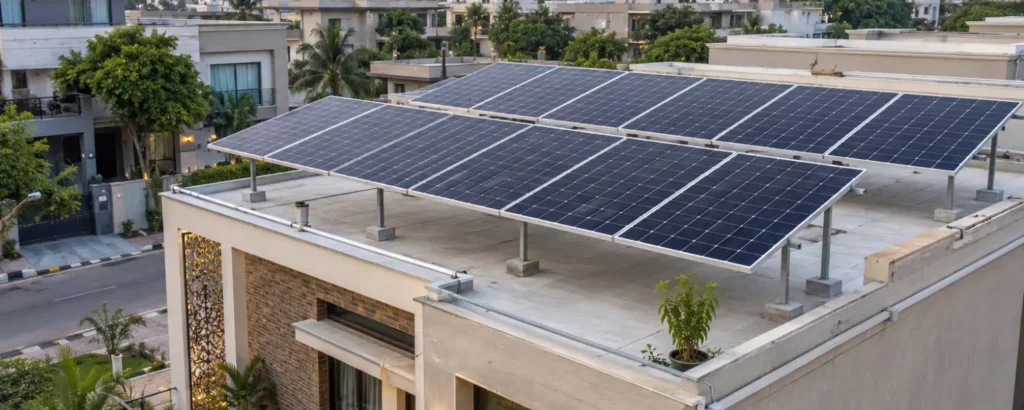
A solar PV module is a panel comprising solar cells that convert the sun’s energy into electrical energy. It forms the core of all domestic, commercial, or industrial solar systems. There are many types of solar panels in India, including monocrystalline, polycrystalline, thin-film, bifacial, and PERC modules. Choosing the best one determines your savings, efficiency, and system durability.
Key Takeaways
- A solar PV module works through the photovoltaic effect and uses sunlight as input to produce electricity.
- The various types are monocrystalline, polycrystalline, thin-film, bifacial, and PERC modules.
- Monocrystalline panels have the maximum efficiency at 18-23%.
- Polycrystalline panels are less expensive but require more roof area.
- Bifacial panels produce electricity from both sides to give high output.
- The cost of solar PV panels in India usually varies between ₹20 and ₹30 per watt.
- Good-quality modules come with a guarantee of 25 years or more.
- BIS and ALMM certifications are important while purchasing modules in India.
What Is a Solar PV Module?
So, what is solar PV module technology? Solar PV or Photovoltaic modules are simply panels containing silicon-based solar cells wired up together. These are encased in toughened glass, EVA encapsulant, a back sheet, and an aluminum frame. There is a junction box at the rear end that helps to export the produced energy. Typically, there are 60 or 72 cells in the commercial module, producing energy ranging from 250 W to 600 W or more.
How Does a Solar PV Module Work?
All solar PV modules depend on the photovoltaic effect. Here’s how it works in easy steps:
- The sun’s rays fall on the silicon cells in the panel.
- Energy from photons is transferred to the electrons of the silicon.
- Electrons begin to move and produce direct current, or DC electricity.
- This DC electricity goes into an inverter.
- The inverter changes DC to AC electricity.
- The AC powers your home appliances or equipment.
Panels are connected in series to increase the voltage and in parallel to increase the current.
What Are the Different Types of Solar PV Modules?
All rooftops or budgets may not suit the same type of solar panel. Below is an in-depth analysis of each kind of module.
Monocrystalline Modules
These panels consist of one pure silicon crystal and have a sleek, uniform black appearance. These panels are most efficient at converting sunlight into energy, with efficiencies of 18% to 23%. Their installation requires minimal roof space, and they can also work efficiently in conditions of insufficient light.
Polycrystalline Modules
These modules are made of melted silicon fragments and have a characteristic blue and speckled design. In terms of efficiency, they are less efficient at 15% to 17%. Nevertheless, they are inexpensive and appropriate for large roofs and grounds.
Thin Film Modules
Thin film solar cells utilise a thin coating of photoactive substance like cadmium telluride or amorphous silicon onto a glass or metal surface. They are lightweight and flexible, but have a relatively low efficiency level of 10% to 14%. More area is required for the same amount of power generation. These modules are effective on commercial rooftops.
Bifacial Modules
Bifacial panels absorb energy both from the front face and the back face of the panel. Light that is reflected by the sand or white gravel increases their power generation. They generate 10% to 20% extra power compared to conventional panels.
PERC and N-Type Modules
The PERC (passivated emitter and rear cell) technology includes adding a reflector behind standard cells to enhance light absorption. This helps increase power and withstands high temperatures. The N-type modules take an extra step by providing higher durability compared to the old P-type solar modules. The P-type modules have a power rate of 550Wp, whereas the N-type has 720Wp.
Comparison Table: Solar PV Module Types at a Glance
| Module Type | Efficiency Range | Typical Lifespan | Ideal For | Relative Cost |
| Monocrystalline | 18% – 23% | 25–30 years | Small roofs needing high output | Higher |
| Polycrystalline | 15% – 17% | 20–25 years | Large roofs, tighter budgets | Lower |
| Thin-Film | 10% – 14% | 10–20 years | Commercial roofs, curved surfaces | Varies |
| Bifacial | 19% – 24%+ | 25–30 years | Ground mounts, reflective sites | Higher |
| PERC / N-Type | 19% – 23%+ | 25–30 years | Hot climates, premium installs | Higher |
What Are the Key Features of Modern Solar PV Modules?
Modern modules include much more than just plain silicon solar cells. Some of the key features are listed below:
- PERC technology to reduce light-induced degradation.
- Multi Busbar (MBB) technology, which reduces the resistive loss.
- High temperature coefficients for consistent energy production even in hot Indian summers.
- PID & Salt Mist Resistance for humid coastal areas.
- IEC/BIS certifications for assurance about quality and safety standards.
- 25-30 years of performance guarantees from the best solar panel company in India.
How Much Does a Solar PV Module Cost in India?
The cost of Solar PV modules depends on their type, capacity, brand, and current costs of materials. On average, good-quality modules in India cost from ₹20 to ₹30 per watt, depending on the cost of silicon and incentives offered by the government.
| Factor | Impact On Cost |
| Module Type | Mono and bifacial cost more than poly |
| System Capacity | Larger systems lower the per-watt price |
| Installation Type | Ground mounts often cost more than rooftop |
| Location and Subsidies | State incentives can reduce net price |
| Brand and Certification | Certified, branded modules cost a premium |
How Are Solar PV Modules Manufactured?
Below are a few steps on how a module is actually manufactured –
- Silicon is refined and processed into ingots, which are cut into wafers.
- The wafers are prepared and doped to produce the layers of positive and negative sides that allow the creation of the photovoltaic effect.
- Printing of metallic contacts on individual cells to collect electricity.
- Cells are tested, sorted according to their power output, and soldered into strings.
- Strings are laminated with glass and backsheets using the EVA film.
- An aluminium frame and junction box are installed for rigidity and connections.
- Complete modules go through flash testing, IEC certification tests, and quality checks before shipment.
It is due to this automation that state-of-the-art manufacturing plants are able to produce hundreds of megawatts every month.
What Happens to Solar PV Modules at the End of Their Life?
This question does not come up frequently, yet it is an important one. After 25-30 years, the modules start producing about 80% of their initial power but have to be replaced finally. Almost all the materials like glass, aluminum, silver, and many others can be recycled. There are some countries that are setting up their own PV recycling plants, and India is formulating policies for e-waste, including solar modules.
Conclusion
Solar PV modules have greatly advanced to give options for all roofs, budgets, and climates. Knowing about the different varieties of solar panels, their characteristics, and the real cost of everything will help you make the right decisions and save money in the process. Want to benefit from the solar panel investment? Reach out to a leading solar manufacturing company in India like Inter Solar and get a custom quote for your project.
Frequently Asked Questions
1. What are the four main types of solar batteries?
There are four primary categories: lead-acid, lithium-ion, nickel-cadmium, and flow batteries. Lead-acid batteries are very inexpensive, but they require frequent maintenance. Lithium-ion batteries are the preferred choice for home solar energy systems due to their long lifespans and minimal maintenance.
2. What is the difference between a solar cell, module, and panel?
The smallest component that generates electrical energy from sunlight is called a solar cell. Cells that are interconnected and enclosed within glass make up the solar module. The term solar panel is sometimes used for both a module and a set of modules.
3. Can solar PV modules work on cloudy days?
Yes, modules do produce electricity even in the presence of cloud cover. Monocrystalline and PERC modules are superior to polycrystalline modules in terms of performance under low light intensity. This is because they have a relatively high base efficiency.