
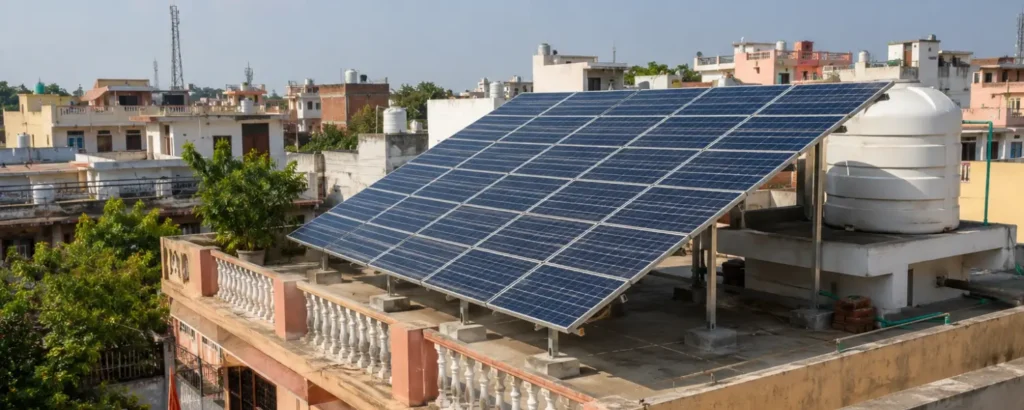
Yes, solar panel investment in India is indeed a good decision for most homeowners in India at this point. The combination of increased electricity charges and decreased cost of technology makes it possible. The payback period on an investment in home solar power panels is normally five to seven years. Afterwards, the electricity will be nearly free for the next fifteen to twenty years.
Key Takeaways
- Return on investment from installing a solar panel in India takes about 5-7 years.
- Solar PV panels are guaranteed to perform well for 20 to 25 years.
- The maximum subsidy provided by PM Surya Ghar Muft Bijli Yojana is up to ₹78,000.
- Installing solar panels in homes helps reduce electricity costs up to 50 to 100 percent.
- Properties with solar panels usually sell faster at better prices.
- If you require power even when there is no electricity supply from the grid, a battery backup is required.
- Choosing the best solar panel company in India determines your gains.
- A solar power system for business yields a good return on investment much earlier.
What Does Solar Panel Investment Actually Mean?
A solar power panel investment includes the installation of photovoltaic panels on the rooftop to produce energy. One spends money on the purchase of panels, inverters, wiring, and mounts. In return, one can get less energy from the electrical grid every month. This gradually repays the original expenditure on solar energy equipment. After that, everything is a gain!
How Much Does a Home Solar Panel System Cost in India?
The cost depends on the size of the system, the quality of the solar panels, your geographical location, and the intricacies involved in the installation process. Below are the approximate costs of the installation, including the available subsidies under government programs.
| System Size | Suitable For | Estimated Cost (Before Subsidy) | Approx. Central Subsidy |
| 1 kW | Small homes | ₹60,000 – ₹90,000 | ₹30,000 |
| 2 kW | Mid-sized homes | ₹1.2L – ₹1.8L | ₹60,000 |
| 3 kW | Medium to large homes | ₹1.8L – ₹2.5L | ₹78,000 (max cap) |
| 5 kW | Large homes | ₹3L – ₹4L | ₹78,000 (max cap) |
| 10 kW | Small businesses | ₹5L – ₹7L | Not applicable (commercial) |
The price will depend on your city, roof condition, and the solar manufacturing company in India you choose. Always request a written estimate before you make any commitment.
What Is the Solar Panel Return on Investment?
Return on investment from solar panels is basically the speed at which your savings are able to pay off the initial cost. The average period for this is around five to seven years in India. More electricity usage and more sunlight in the region reduce the payback period even further. Once the payback stage ends, you start making profits from your solar panels for many years ahead.
There are several variables that will affect your actual return on investment from your solar panels:
1. The amount of electricity that you use monthly and your tariff slab.
2. Availability of sunshine at your particular location.
3. Size of your solar power generation system.
4. Net metering availability in your state for exporting excess energy.
5. The installation quality offered by your solar energy company.
Are Solar Panels a Good Investment for Indian Homeowners?
Solar panels work out well for the majority of homeowners in India. Solar energy can save money owing to high electricity rates in urban areas. Financial help from the government through programs such as PM Surya Ghar cuts down the initial expense significantly. The primary requirement is having adequate direct sunlight hitting your roof throughout the day. If your roof is facing south without much shade, then you have hit the jackpot.
What Government Subsidies Support Solar Panel Investment in India?
The PM Surya Ghar Muft Bijli Yojana is the largest subsidy scheme in India. According to this scheme, one receives ₹30,000 for every kW for the first two kW of the solar panels. For the third kW, one gets ₹18,000, making the maximum subsidy amount ₹78,000. Top-up subsidies are also available for certain states, such as Rajasthan. The subsidy amount will be credited directly into your bank account post-installation and inspection.
Pros of a Solar Panel Investment
1) Lower bills, sometimes by half or even much more.
2) Savings in the long run after passing the payback period.
3) Increased home value if you have solar power panels installed.
4) Little to no maintenance needed except for occasional cleaning and once a year inspection.
5) Insulation from increases in future electricity prices by your DISCOM.
6) Reduced greenhouse gas emissions and less dependence on fossils.
Cons and Challenges to Consider
1) The initial expenditure may still be on a higher side for many families.
2) You require sufficient space on your roof with sunlight exposure for maximum production.
3) Power production is lower when it rains or when you live in a cloudy area.
4) Installation of batteries to cover power outages is extremely expensive.
5) Incorrect installation results in inefficiency and a shorter life of panels.
Are Solar Panels Worth the Investment for Businesses?
Businesses generally benefit from quicker paybacks due to their higher consumption of energy. The installation of a solar power system in commercial establishments will be able to cover a substantial percentage of daily electrical expenses. This is why factories, offices, warehouses, and educational institutions are now opting for solar power. Commercial applications also help achieve the objective of sustainability and enhance the reputation of the firm. Also, for companies that consume a lot of electricity during the day, there is an even greater reason for installing such panels.
How to Choose the Best Solar Panel Company in India
1. See how long the company has been working in this industry.
2. Review the warranty period; there should be at least 20-25 years for panels.
3. Check if the company manages subsidy applications and net metering installations.
4. Check genuine customer reviews rather than relying on the testimonials on their company profile.
5. Confirm after-sales service because the panels will need some maintenance during their lifetime.
Using a Solar Panel Investment Calculator
The solar panel calculator gives you an idea about the costs, savings, and return on your investment before making your decision. All you need to do is enter the amount you spend on electricity bills each month, the size of your roof, and your location. The calculator will then determine your system size, eligibility for subsidies, and your monthly savings. You’ll be negotiating from a stronger position.
Practical Details That Affect Your Solar Investment
Panel degradation is normal, not a fault.
Solar panels experience an annual loss of efficiency by about 0.5 to 0.8%. However, this is already accounted for in the panel’s guarantee, and so it does not affect the performance of the solar panel even after 25 years of its lifespan. This just means that the benefits will reduce gradually instead of remaining constant.
Monocrystalline and polycrystalline panels are not the same investment.
The cost of monocrystalline panels is relatively higher than that of polycrystalline panels; however, they perform better in cloudy weather conditions. Polycrystalline panels are less expensive and work well in areas where there is direct sunlight. It is essential to choose your type of panel depending on the climate.
Insurance can protect your investment, too.
Many homeowners tend to ignore the fact that these panels are susceptible to storm and hail damage as well. Many home insurance companies in India have begun to provide coverage for solar installations on rooftops, making it advisable to check with your insurance company.
Financing makes the upfront cost easier to manage.
Many banks and solar energy firms provide free-of-cost schemes of EMI where one pays in installments for the installation rather than in a single payment. It may be wise to opt for such an option even if one is capable of paying up front.
Net metering approval takes longer than the installation itself.
After the installation of your system, you need to wait for your local DISCOM to examine the system and give the green signal for net-metering. This process may take a few weeks, so do not expect immediate savings on your electricity bill.
Conclusion
Investing in solar panels is indeed profitable for most Indian homeowners who have access to sunlit roofs. Due to the declining costs of technology, favorable subsidies, and increased electricity rates, the advantages of solar energy are obvious. Just do your research about the system size and choose the right solar energy provider to make solar energy the best investment for you.
Frequently Asked Questions
- Are solar panels a good investment in India?
Certainly. Higher electricity costs, declining prices for solar panels, and government rebates ensure that solar energy is financially viable. The typical payback period of solar energy systems is usually five to seven years, after which the electricity becomes practically free. - What is the average solar panel return on investment?
Solar panel payback time in India usually lies within the range of five to seven years, although it varies according to location, sunlight exposure, and the quantity of electricity used per month. The more you use electricity, the shorter the payback period becomes. - How long do solar PV panels actually last?
Solar PV panels generally have performance warranties that last from 20 to 25 years. They will produce energy even after their warranty periods, but their energy production rates will decline because of the annual degradation of their cells. - Do solar panels work during a power outage?
Not generally, unless you have a battery backup system. Normal grid tie systems will shut themselves down automatically in the event of a power outage because of safety concerns. For an uninterrupted source of power, a hybrid system with battery backup is required.