
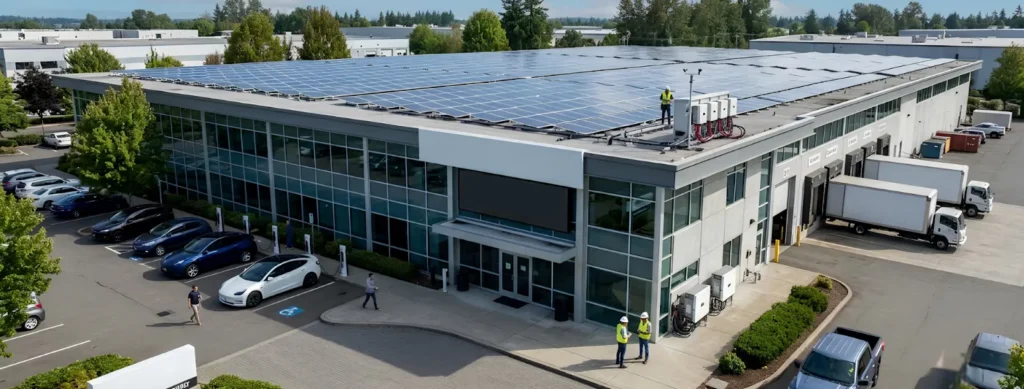
Yes, solar panels for commercial buildings are worth the investment for the majority of Indian businesses. This saves on electricity expenses, helps to insulate companies from future tariff increases, and also pays for itself in three to seven years. Additionally, there are many state benefits, including accelerated depreciation, that further improve the numbers. Also, commercial solar power improves the environmental image of your company with consumers and stakeholders. For most offices, factories, and warehouses, the returns clearly outweigh the upfront cost.
Key Takeaways
- Solar panels for commercial buildings typically pay back their upfront cost in 3 to 7 years.
- Commercial solar panels help save on monthly electricity bills by harnessing free daylight energy.
- Business organisations are eligible for accelerated depreciation and subsidies for commercial solar panel installations.
- Through net metering, you can make money from the excess energy that you feed into the grid.
- A properly designed industrial solar power system requires less roof area than most think.
- Selecting the best solar panels company in India is more important than looking for the cheapest.
- Commercial solar panels can also increase the property value when selling.
What Exactly Do Solar Panels for Commercial Buildings Do?
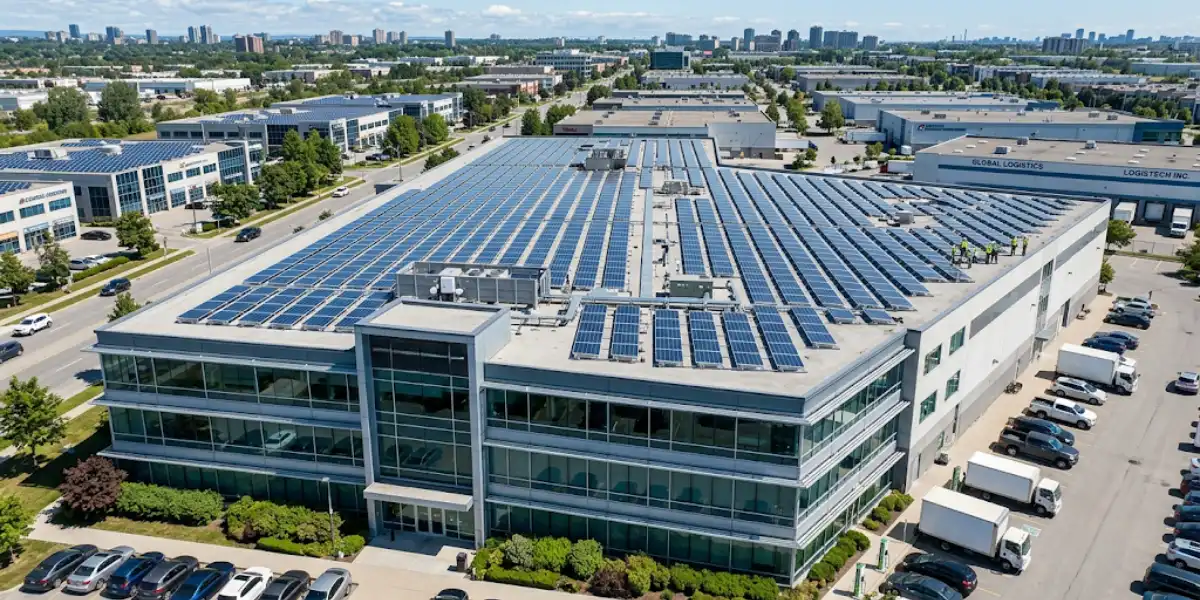
Commercial solar panels generate electricity using the energy from the sun. The photovoltaic cells collect sunlight and release electrons, generating electrical current. This will power your lights, machines, air conditioners, computers, and other office equipment during the daytime.
The surplus electricity generated can either be stored or fed back to the grid. Commercial building solar panels are different from home-based solar panels since they have to cater to much larger loads. Office buildings, industrial plants, hotels, and hospitals use power around the clock. Therefore, this daytime demand pattern matches solar generation almost perfectly.
Why Are Businesses Switching to Commercial Solar Power?
Tariffs on electricity for commercial and industrial connections are continually increasing in the majority of the states in India. Business establishments spend much more on every single unit of electricity compared to residential customers. In such a scenario, commercial solar panel installation is financially attractive from day one.
Moreover, solar panels for industrial use prove equally beneficial for factories and warehouses. Today, many companies feel a lot of pressure from their customers and investors to lower emission levels. Installation of industrial solar power systems is a clear sign of environmental consciousness rather than just talk.
What Are the Real Benefits of Commercial Solar Panels?
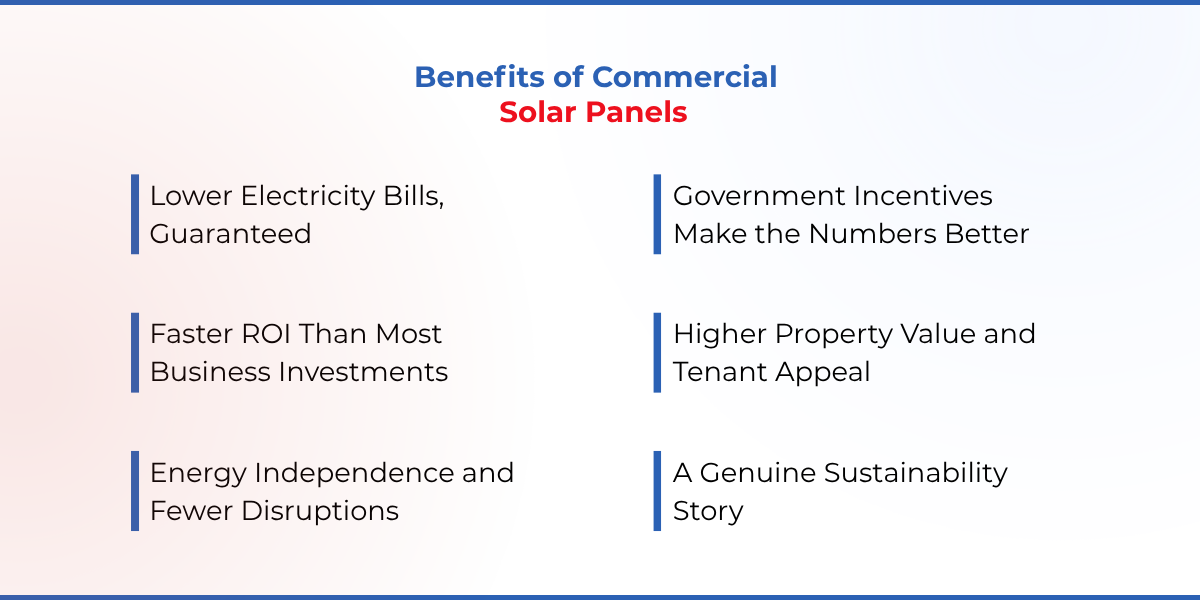
Lower Electricity Bills, Guaranteed
Energy usage is generally at its maximum in commercial buildings during daytime. It is perfectly coordinated with the peak solar production time of your solar panels. In turn, it helps businesses reduce a considerable part of their energy costs. Over 25 years, these savings often run into several lakhs. That money can be reinvested into equipment, staff, or expansion instead.
Faster ROI Than Most Business Investments
It takes anywhere from three to seven years for most commercial solar panel installations to pay for themselves. Once this happens, all of the electricity generated by the system is basically free. Government subsidies, which include accelerated depreciation, make the payback period even shorter.
Energy Independence and Fewer Disruptions
Electricity failures in the grid can shut down the production process suddenly. The use of solar energy helps eliminate this kind of problem. The inclusion of battery backup makes this much more efficient. Businesses that function continuously get great benefits from this feature. You remain productive even when the local grid struggles.
Government Incentives Make the Numbers Better
Indian companies may benefit from accelerated depreciation on the use of solar energy, resulting in a substantial reduction in taxable income. Many of the state electricity boards provide subsidies or lower the connection charges. The practice of net metering helps you sell excess energy generated back to the grid. Hence, together, these incentives noticeably shorten your payback period.
Higher Property Value and Tenant Appeal
Properties fitted with solar power systems tend to enjoy an increase in resale value. This is because both the buyer and tenants see the potential for lower expenses in the future. Reduced operating costs give an edge to a particular property in the market. Furthermore, this applies to office parks, retail spaces, and industrial sheds alike.
A Genuine Sustainability Story
Clients, investors, and employees prefer to work with organisations that have made genuine commitments towards environmental responsibility. Solar panels for commercial use are one way to prove your organisation’s dedication to sustainability, not only on paper but in practice. In fact, this can influence contracts, funding decisions, and hiring outcomes over time. Therefore, sustainability is no longer optional for serious businesses.
How Much Does Commercial Solar Panel Installation Cost in India?
The cost depends on the size of the system, the quality of the panels, and the environmental conditions of the place. In India, for a commercial rooftop solar system, the cost per kW can be from ₹32,000 to ₹50,000. The bigger the size of the system, the lower the cost per kW. This table will give you an estimate.
| Building Size | Approx. System Cost | Best Suited For |
|---|---|---|
| Small commercial | ₹6 – 10 lakh | Clinics, small offices, retail stores |
| Medium commercial | ₹25 – 40 lakh | Hotels, hospitals, mid-sized offices |
| Large commercial or industrial | ₹1 – 1.5 crore | Factories, IT parks, malls |
The majority of the cost is allocated to the solar panels, inverters, mounting systems, and labor involved. Permitting and design are part of the soft costs that are also included in the cost calculation. A reliable installer will explain this to you before proceeding.
On-Grid, Off-Grid, or Hybrid: Which Suits Your Business?
Each company does not necessarily require the same type of solar panels for commercial buildings.
- On-grid systems are those that are tied into the electrical grid network and use net metering. They are best suited for most office buildings and retail establishments with constant power demands during the day.
- Off-grid systems operate on batteries and have no connection to the grid whatsoever. They can be used in remote locations where there is unreliable access to the electrical grid.
- Hybrid systems use a combination of solar, battery storage, and utility power for maximum reliability. Hospitals, data centers, and factories with critical loads use this option.
NOTE: Your energy consultant should recommend a setup based on your load profile and budget.
What Financing Options Exist for Commercial Solar Panel Installation?
Purchasing the system by utilising cash will provide the best ROI in the long term. There are also other alternatives available for businesses that do not have any cash upfront:
- The solar loan allows you to purchase the system and pay for it gradually.
- Power Purchase Agreements (PPAs) mean that the third party will own the system, and you just need to pay for electricity.
- Operating leases allow the use of the equipment at a fixed cost per month.
Each option suits different cash flow situations, so compare them carefully before deciding.
What Are the Challenges of Going Solar Commercially?
Solar panels for commercial buildings are not free from challenges either. The initial investment may be high despite the presence of various financing solutions. Shaded roofs could prevent sufficient electricity generation. Permits, approval for net metering, and grid connection could take time as well.
So, hiring an experienced and trustworthy installer will help you overcome these difficulties easily. And that is why choosing the best solar panel company in India is important.
How Do You Choose the Right Commercial Solar Panel Installation Partner?
- Check whether the company is also a solar manufacturing company in India, since this often means better quality control.
- Ask for case studies or references from similar commercial or industrial clients.
- Compare warranty terms on panels, inverters, and workmanship separately.
- Confirm they handle permitting, net metering, and commissioning end-to-end.
- Look for after-sales service and monitoring support, not just installation.
A reliable partner turns a good investment into a genuinely great one.
What Maintenance Does an Industrial Solar Power System Need?
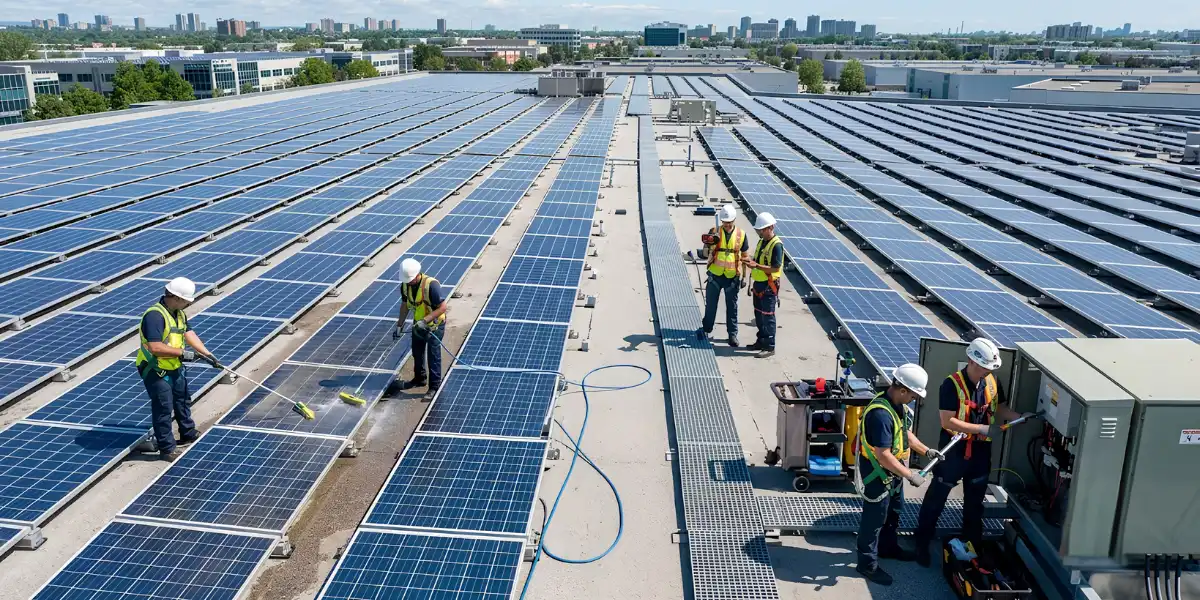
Solar panels do not have any movable parts and hardly ever malfunction. Maintenance only requires regular cleaning of the solar panels to keep them free of any dirt or debris. The inverters normally need replacing once every 25 years.
Annual electric inspection can identify any small problem that may affect performance in the future. Several providers are now offering real-time monitoring, which will highlight any problems instantly. Light maintenance budgeting will take care of your investment in the long run.
Solar Panels for Commercial Buildings: Is the Investment Really Worth It?
For most Indian businesses, the answer is a clear yes. Solar power for commercial purposes brings with it several benefits such as cost savings, energy security, and a better sustainability angle to their operations. Additionally, the return on investment period for solar power is shorter than that of any other investment that companies make. Therefore, if you run a factory, hotel, or office, solar panels for commercial use make sound business sense.
Conclusion
Solar panels for commercial buildings present an exceptionally unique blend of cost reduction, safety, and environmental protection. In view of decreasing prices and rising incentives, there has perhaps never been a better time to invest in solar energy. It is as important to choose the right company as it is to make the decision. Want to reduce your electricity bill? Request a free quote now.
Frequently Asked Questions
1.Will solar panels work during a power outage?
Grid-tie systems automatically shut down in case of blackouts for safety reasons. The battery backup system will help run critical loads irrespective of any grid failures.
How long do commercial solar panels last?
Typically, most commercially available solar panels have 25 years warranty period, and even after this period, they continue to produce power for 30 years or more. However, inverters and batteries might need replacement sooner.
Can I lease a solar system instead of buying it?
Yes, leasing and Power Purchase Agreements enable businesses to use solar technology without high initial costs, but direct ownership will yield greater ROI.
Does the roof need checking before installing solar panels?
Definitely, an aged roof needs repair or replacement prior to installation, as it can cause problems during the installation process.
What financial incentives exist for commercial solar in India?
Indian enterprises get benefits of accelerated depreciation, government subsidies, and net metering, making their investments more attractive.