
Most households already have a hot water system. The question is, how does it still benefit the household? With larger families, extended usage windows, and multiple bathrooms, many geyser configurations begin to feel inefficient.
This is where solar water heaters come into play as a sensible upgrade, not a status symbol. Two technologies have cornered the market in India today: Evacuated Tube Solar Water Heaters and Flat Panel Solar Water Heaters. This guide will examine how both work, where each is better suited, and how to pick one based on operating conditions.
What Is a Solar Water Heater?
A solar water heater is, quite simply, a device that uses the solar energy to heat water and store it for later use. There is no electricity used in the heating process, only the solar power and simple heat transfer.
The device sits silently on the roof top, soaking up the heat of the sun during the day and transferring it to an insulated storage tank. By the time hot water is needed, usually in the morning or evening, the job is already done.
In most homes, solar water heaters do not replace the existing system. They cut down the number of times electric geysers are used. That reduction is where the long-term savings come from, not from chasing “free energy”.
Evacuated Tube Solar Water Heaters
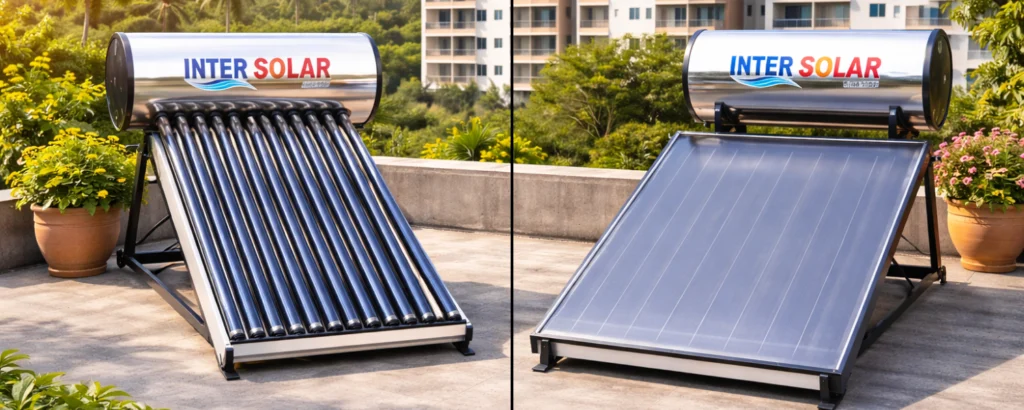
The Evacuated Tube Solar Water Heaters are unique in appearance. They have rows of glass tubes, tilted slightly, which stand out prominently on rooftops.
The advantage of these tubes is that they have a vacuum that cuts down on heat loss. This is the actual benefit in this case.
These solar water heaters work well in areas that are cold, have foggy mornings, or where the sun doesn’t shine directly. They heat water quickly and keep it hot for longer, even when it is a cloudy sky.
This is why Evacuated Tube Solar Water Heaters are popular in:
- North Indian cities
- Hill stations
- Houses where hot water is required early in the morning
They are efficient, but also fragile. The tubes can be damaged if not handled carefully, and water quality is even more important in this case than one might think.
Flat Panel Solar Water Heaters
Flat Panel solar water heaters are less complex in design and functionality. A flat absorber plate is placed beneath the toughened glass, warming water in pipes at the rear of the panel.
They do not heat as strongly as evacuated tubes, but they are consistent and robust. In areas with regular sunlight, they work well with little maintenance. They are heavier, more robust, and easier to maintain.
Flat Panel Solar Water Heaters are commonly used in:
- Apartments
- Office buildings
- Areas with regular high levels of sunlight throughout the year
How the Solar Water Heating Systems Work
Both the evacuated tube collector and flat plat solar water heaters operate on the same principle, even though they are built differently.
- Sunlight shines on the surface of the collector.
- Heat builds up inside the collector.
- Water absorbs the heat and flows into an insulated tank.
- Hot water is stored inside the tanks.
There is no motor involved in circulating water in most domestic systems. Gravity is the power behind the system. Hot water rises, and cold water follows, and this process goes on all day. This is why solar water heaters have such a long life span when installed properly.
Key Differences Between Evacuated Tube and Flat Panel Systems
Let’s understand the differences between evacuated tube and flat panel systems:
| Factor | Evacuated Tube | Flat Panel |
| Performance in cold weather | Very strong | Moderate |
| Durability | Moderate | High |
| Heat retention | Excellent | Good |
| Maintenance | Slightly higher | Lower |
| Roof load | Lighter | Heavier |
The table helps, but the real decision comes down to roof conditions, climate, and daily usage. Not brand names.
Efficiency in Indian Climate Conditions
India isn’t one climate. What works well in Jaipur may not suit Bengaluru. Evacuated Tube systems shine where mornings are cold and sunlight is inconsistent. Flat Panels do better where sunlight is steady and roofs are large and unobstructed.
Neither system is universally better. That’s an uncomfortable truth most brochures avoid.
Advantages and Limitations of ETC and FPC Solar Water Heaters
Evacuated tube systems offer better heat retention and flexibility but require careful handling during installation and occasional tube replacement.
Flat panel systems are mechanically robust and visually cleaner, but may lose efficiency in colder or cloudy conditions.
Neither system is universally better. The balance lies in matching the system to actual household behaviour rather than ideal assumptions.
Which Solar Water Heater Is Right for Your Home?
Start with usage. How many bathrooms? What time is hot water used? Is the roof shaded? Is water hard?
Then look at structure. Roof strength matters more than people think. So does installation quality.
This is where experienced solar water heater manufacturers matter. Not because of branding, but because poor design choices show up years later, not immediately.
Final Thoughts
Solar water heaters are not exciting technology. That’s exactly why they work. No electronics. No apps. No daily interaction.
When matched properly to a home, both Evacuated Tube and Flat Panel systems quietly reduce electricity use for years. The key isn’t choosing the “best” system. It’s choosing the one that fits how the household actually functions.
Frequently Asked Questions
1. Do solar water heaters work during power cuts?
Yes. Solar heating works independently of electricity. Only the backup heater requires power, so hot water is usually available even during short outages.
2. How long does solar-heated water stay hot?
With proper insulation, stored water can remain hot for 24 hours or more, depending on usage and weather conditions.
3. Is hard water a problem for solar water heaters?
Hard water can cause scaling over time. Periodic maintenance and proper material selection help minimise long-term issues.
4. Do these systems require frequent servicing?
Maintenance is minimal. Occasional cleaning and inspection are usually sufficient to keep systems running efficiently.
5. Can capacity be increased later if usage grows?
Yes. Many systems allow capacity expansion by adding collectors or upgrading storage tanks, depending on installation design.