
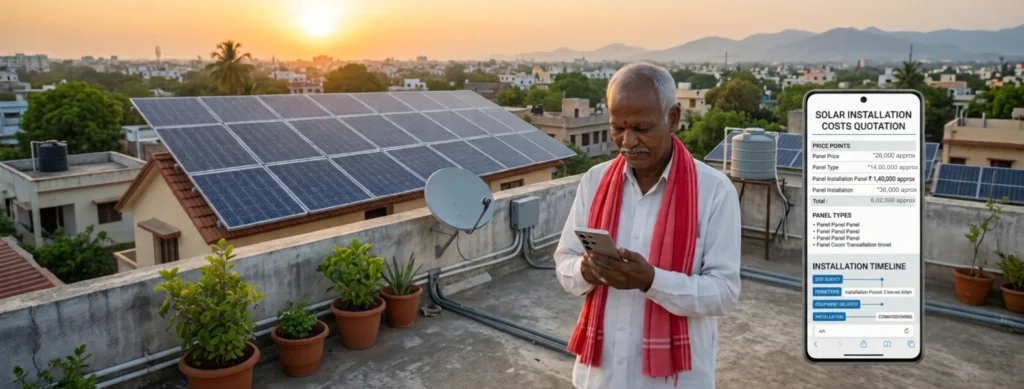
The average cost to install solar panels for a typical Indian home ranges from ₹60,000 to ₹6.5 lakh. Your actual costs will depend on the system size, solar panels used, and the location of your city. A typical household will require between a 2kW to 5kW system, which can cost you around ₹1.1 lakh to ₹3.85 lakh without any subsidy. The PM Surya Ghar scheme cuts this cost by up to ₹78,000.
Key Takeaways
- The cost to install solar panels ranges from ₹60,000 (1 kW) to ₹6.5 lakh (10 kW).
- A 3 kW on grid solar power system for home suits most Indian households.
- The central subsidy under PM Surya Ghar goes up to ₹78,000 per home.
- A Rooftop Solar panel system needs 80 to 450 sq. ft. of shade-free roof space.
- A Solar Panel Investment usually pays back within 3 to 5 years.
- Choosing a reliable Solar manufacturer in India protects your long-term output.
- Solar PV Panels keep generating for 25-plus years, though output slowly declines.
What Factors Decide the Cost to Install Solar Panels in India?
All solar quotations will differ from one another, which is why most consumers find them quite confusing. There are certain real-life factors that affect the cost of your solar panels and need to be considered before comparison.
- System size (kW capacity): Large houses that have air conditioners and geysers require larger systems, making the total price go higher.
- Type of solar panels: Monocrystalline panels are expensive but efficient, while polycrystalline panels are economical yet have medium efficiency.
- System type: The grid-connected system is the most cost-effective one; hybrid and off-grid systems are costly due to batteries.
- Brand and quality of panels: Trusted brands offer better warranties, though their upfront solar panel price runs higher.
- Condition of roof: Old roofs, tin roofs, or uneven-surfaced roofs increase installation and mounting costs.
- Place and labour cost: Metro areas have comparatively higher labour costs compared to small towns.
What Is the Average Cost to Install Solar Panels by System Size?
Here is a realistic, India-wide cost table based on current market data and government subsidy slabs.
| System Size | Estimated Cost (Before Subsidy) | Central Subsidy | Approx. Cost After Subsidy | Ideal For |
|---|---|---|---|---|
| 1 kW | ₹60,000 – ₹85,000 | ₹30,000 | ₹30,000 – ₹55,000 | Small homes, 1 BHK |
| 2 kW | ₹1.1 lakh – ₹1.8 lakh | ₹60,000 | ₹50,000 – ₹1.2 lakh | 1–2 BHK homes |
| 3 kW | ₹1.8 lakh – ₹2.5 lakh | ₹78,000 | ₹1.02 lakh – ₹1.72 lakh | 2–3 BHK, average home |
| 5 kW | ₹2.75 lakh – ₹3.85 lakh | ₹78,000 (cap) | ₹1.97 lakh – ₹3.07 lakh | Large homes, villas |
| 10 kW | ₹5.5 lakh – ₹6.5 lakh | Not applicable | — | Big villas, small business |
These figures include panels, inverter, mounting, wiring, and basic installation labour. Always ask for a written, itemised quote before signing anything.
What Does Each Solar Component Cost?
Your cost to install solar panels is not just the panel price. Every part of the system adds to the final bill.
| Component | Cost Range | What Affects It |
|---|---|---|
| Solar PV Panels (per kW) | ₹22,000 – ₹42,000 | Efficiency, brand, warranty years |
| Solar inverter | ₹20,000 – ₹80,000 | Type, brand, warranty |
| Mounting structure | ₹10,000 – ₹50,000 | Material and roof type |
| Wiring and cables | ₹8,000 – ₹25,000 | Copper quality, cable sizing |
| Protection devices | ₹5,000 – ₹15,000 | Number of safety fittings |
| Installation labour | ₹10,000 – ₹40,000 | Roof difficulty, team skill |
| Net metering paperwork | ₹3,000 – ₹10,000 | State DISCOM fees |
Want panels with a strong warranty? Browse Inter Solar’s Solar PV Panels range before you finalise your quote.
How Much Roof Space Does a Rooftop Solar Panel System Need?
A rooftop solar panel system requires shade-free, usable roof space, not the entire terrace area that you have. South-facing is ideal for Indian households.
| System Size | Minimum Roof Area | Panels Needed (approx., 400W each) |
|---|---|---|
| 1 kW | 80–100 sq. ft. | 2–3 panels |
| 2 kW | 160–200 sq. ft. | 4–5 panels |
| 3 kW | 250–300 sq. ft. | 6–8 panels |
| 5 kW | 400–450 sq. ft. | 12–13 panels |
| 10 kW | ~800 sq. ft. | 24–25 panels |
While east- or west-facing roof space can be used as well, they produce 10% to 20% less electricity than a south-facing roof system.
On Grid Solar Power System for Home vs Off-Grid: Which Saves More?
Most Indian city houses go for the grid-tied solar energy system due to its low cost and quick payback period. The system is simply connected to your grid system and does not use batteries.
| Feature | On-Grid | Off-Grid |
|---|---|---|
| Battery required | No | Yes |
| Government subsidy | Available | Not available |
| Works during power cut | No | Yes |
| Overall cost | Lower | Higher |
| Best for | Reliable grid areas | Remote, unreliable grid areas |
If your area has a stable grid connection, an on grid solar power system for home remains the smarter, cheaper choice. Read our full on grid solar power system for home guide for installation steps and detailed pricing.
Is a Solar Panel Investment Worth It in India?
Absolutely, making an investment in solar panels is sensible for the majority of Indian homeowners at present. The cost of electricity goes up annually in most states. Simultaneously, the prices of solar equipment continue to fall. Together, these trends shrink your payback period.
- The payback period is about 3 to 7 years, depending on the usage and amount of sunshine received.
- Bills can be reduced by 50% to 100% for homes.
- The resale value is high for homes that have installed solar panels.
- Minimal maintenance: requires only regular cleaning and yearly inspection.
Learn more in our detailed solar panel investment guide, covering ROI calculations and financing options.
What Happens to Solar Panels After 25 Years?
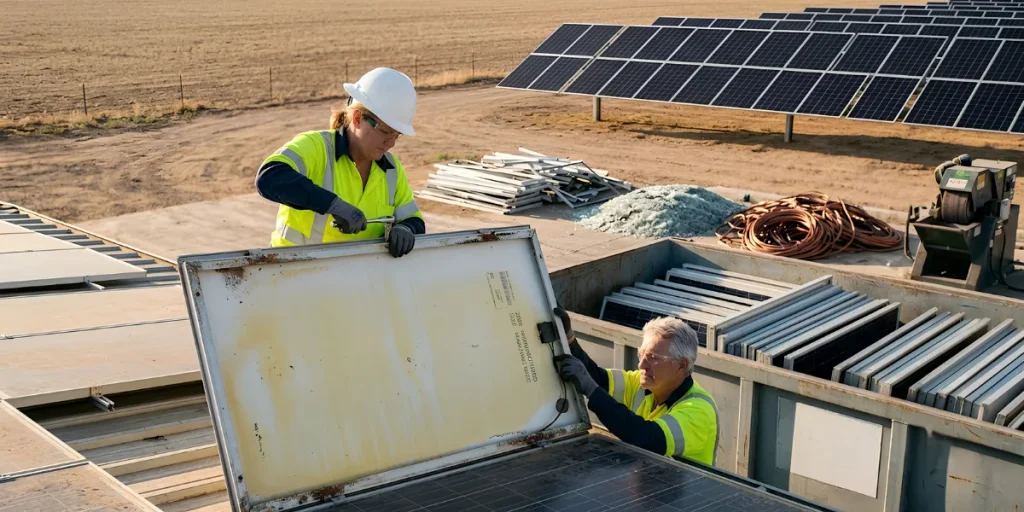
Just because solar panels are not under warranty for 25 years does not mean they will stop producing electricity after that period. Solar panels will continue producing electricity, although at a reduced efficiency level.
- Gradual degradation, not shutdown: Panels degrade by about 0.5 to 0.8 percent per year, not all at once.
- Repowering possibility: Most consumers replace their old panels with new, high-efficiency panels after 20 years of use.
- Replacement of inverters comes first: Inverters have to be replaced after 10-12 years, long before the panels.
- Recycling norms emerging: India is building formal solar panel recycling infrastructure for end-of-life modules.
- Usage continues: Unless your energy needs have increased substantially, the old system can still easily meet your demands.
Planning for this stage, right from day one, protects your long-term solar panel investment.
Which Solar Manufacturer in India Should You Choose?
Installer quality is as important as system capacity. A trusted Solar manufacturer in India can influence warranty claims, subsidy applications, and longevity.
- Look out for panels that are ALMM-listed and DCR-compliant for applying for subsidies.
- Choose a manufacturing company that manufactures and sells its panels rather than distributing other brands.
- Ensure that you get panels with a warranty period of 20 to 25 years.
- Enquire whether they take care of the subsidy application and net metering process.
- Do read unbiased customer reviews rather than testimonials.
Inter Solar designs, manufactures, and installs full rooftops in all parts of India. Many homeowners, however, combine the rooftop installation with a Heat Pump or Solar Water Heating System to further reduce energy costs. Have a look at all that Inter Solar has on offer before finalising your vendor.
Conclusion
The cost to install solar panels for a typical Indian home usually falls between ₹60,000 and ₹3.85 lakh before subsidy. With government subsidies, this figure can be considerably reduced for most families. If you have the correct rooftop area, panel quality, and installation, solar power is one of the safest investments that can be made at home. Go for a reliable Solar company in India like Inter Solar.
Frequently Asked Questions
Does the PM Surya Ghar subsidy cover the full solar panel price?
No, it covers only part of the cost. The subsidy offers ₹30,000 per kW for the first 2 kW, plus ₹18,000 more for the third kW, capped at ₹78,000 total for residential systems above 3 kW.No, it covers only part of the cost. The subsidy offers ₹30,000 per kW for the first 2 kW, plus ₹18,000 more for the third kW, capped at ₹78,000 total for residential systems above 3 kW.
How much roof space do I need for a 5 kW rooftop solar panel system?
A 5 kW rooftop solar panel system needs roughly 400 to 450 sq. ft. of shade-free roof area. This should be usable, structurally sound space, ideally facing south, and free from shadows between 9 am and 5 pm.
What is the payback period for a solar panel investment in India?
Most homeowners recover their solar panel investment within 3 to 7 years, depending on electricity usage, local tariffs, and sunlight availability. After this payback period, electricity generated from your rooftop system becomes almost entirely free savings.
On grid or off grid: which solar power system for home is cheaper?
An on grid solar power system for home is cheaper because it skips batteries entirely and qualifies for government subsidies. Off-grid systems cost more due to battery banks but work during power cuts, making them better suited to areas with an unreliable grid.