
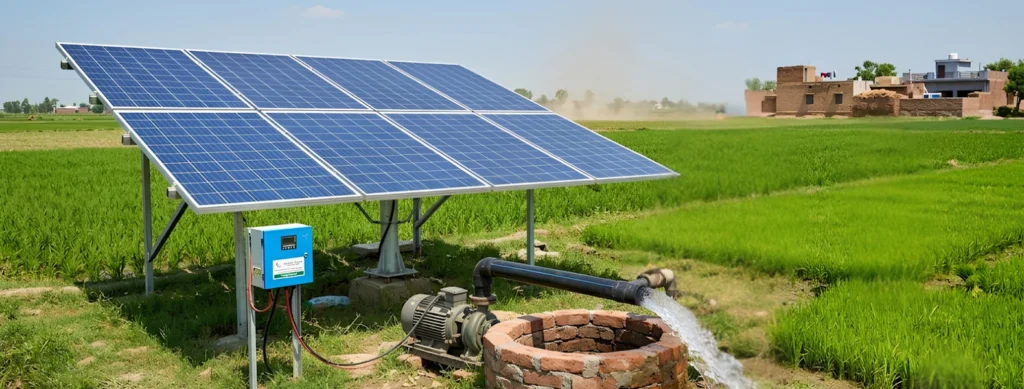
Solar Pumps are pumps that work through electricity that is produced through solar panels rather than the use of diesel or electricity. The water is drawn out from wells, bore wells, rivers, or canals by the use of the sunlight. Farmers make use of the solar power irrigation system to irrigate fields, provide drinking water, and meet livestock needs. A solar water pumping system is very effective where there is no electricity supply.
Key Takeaways
- A solar pump uses solar energy to generate electric power used by the water pump motor.
- There are two types of solar pumps: surface solar pumps and submersible solar pumps.
- Depending on their construction, solar pumps are also powered by AC or DC motors.
- Government of India gives subsidies to farmers through the PM-KUSUM Yojana scheme.
- Using a solar agriculture pump lowers operating expenses to zero after its installation.
- The price of Solar Water Pumping Systems varies from about Rs. 70,000 to Rs. 7.3 lakh, based on capacity.
- Inter Solar is acclaimed as the best solar pump company in India.
What Is a Solar Pump and How Does It Work?
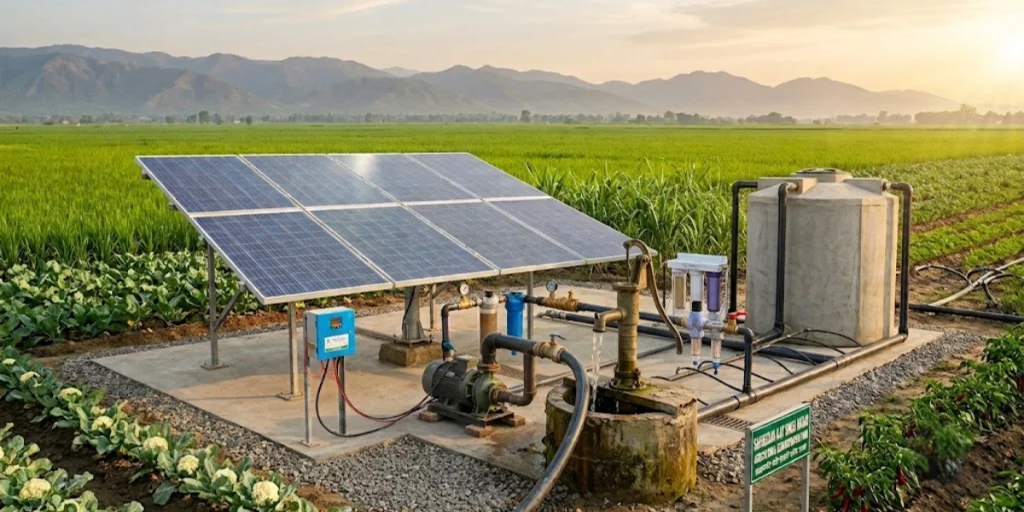
In a solar-powered pump, the Sun’s energy is harnessed by means of Solar Panels using the process known as the photovoltaic effect. The Sun’s energy is transformed into DC electricity, which powers the motor driving the water pump. The motor draws water from a nearby water source and supplies it where it is required.
Different from diesel-powered pumps, a solar-powered pump does not use any fuel. It uses sunlight energy, hence making the operational costs nearly zero after installation. This makes solar water pumps for agriculture especially useful for farmers in remote or off-grid villages.
Main Components of a Solar Pump
| Component | Role |
|---|---|
| Solar panel | Converts sunlight into DC electricity |
| Pump controller | Regulates power flow to the motor |
| Solar inverter | Converts DC to AC (only needed for AC pumps) |
| Motor (AC or DC) | Drives the pump to draw water |
| Battery (optional) | Stores power for use at night or on cloudy days |
| Piping and wiring | Connects components and delivers water |
What Are the Types of Solar Pumps?
Solar pumps are mainly classified by placement and by the current they use. Understanding both helps you pick the right solar agriculture pump for your land.
By Placement: Surface vs Submersible:
| Feature | Surface Solar Pump | Submersible Solar Pump |
|---|---|---|
| Water source depth | Less than 10 metres | 50 to 150+ metres |
| Installation | Above ground, near the source | Fully underwater |
| Best for | Ponds, canals, rivers, tanks | Borewells, deep wells, tube wells |
| Maintenance | Easier, always accessible | Harder, needs removal to inspect |
| Cost | Lower | Higher |
By Current: AC vs DC Solar Pumps
DC pumps used with solar power do not require an inverter to connect to the solar panels. DC solar pumps are best for small farms and lower water heads. AC solar pumps require an inverter, but they work with higher flow rates.
How Does a Solar Water Pumping System Work, Step by Step?
- The solar panels receive sunlight and produce DC electricity through the photovoltaic effect.
- The controller then transfers the energy to the motor, converting the energy into AC where necessary.
- The motor drives the pump, and it begins pumping water from the water source.
- Water moves through pipes into fields, reservoirs, or houses for use.
What Are the Benefits of a Solar Agriculture Pump?
Solar agriculture pumps bring several practical advantages over diesel alternatives. First, they require minimal operating costs, as solar energy is available at no cost, unlike diesel and grid power. These pumps also require little maintenance as they have fewer components than diesel engines. Secondly, these pumps are expected to last for quite some time; in most cases, for 10 to 20 years.
Moreover, these pumps are silent in their operation, as there is no engine noise involved, unlike diesel pumps. They are also environmentally friendly as they emit nothing compared to diesel-powered pumps. These pumps are also very reliable in areas that do not have grid power at all or have intermittent supplies. Finally, government subsidy support makes the upfront cost easier to manage for farmers switching to solar.
Solar Pump vs Diesel Pump: Which Is Better?
| Feature | Solar Pump | Diesel Pump |
|---|---|---|
| Running cost | Nearly zero after setup | High, ongoing fuel expense |
| Installation cost | Higher upfront | Lower upfront |
| Maintenance | Low, few moving parts | Frequent, due to engine wear |
| Environmental impact | Clean, no emissions | Pollutes air, releases carbon |
| Subsidy available | Yes, under PM-KUSUM | No |
| Noise | Silent | Noisy |
What Are the Common Uses of Solar Pumps in India?
Solar water pumps for agriculture remain the biggest use case across rural India. However, applications extend well beyond farming.
- Irrigation of crops using drip irrigation, sprinkling, or flooding techniques.
- Provision of drinking water to houses in villages that lack proper piping.
- Providing water for animals such as cows, goats, and fowls in arid areas.
- Meeting the water requirements of greenhouses, polyhouses, and horticulture.
- Community water works and drinking water projects for the rural population.
- Supporting aquaculture and fish farming operations in coastal belts.
- Watering in hotels, resorts, and other commercial-industrial areas.
What Subsidy Is Available for Solar Pumps in India?
Component B of the PM-KUSUM Yojana is related to installing solar pumps independently. For most of the states, the central government provides a subsidy of 30% on the cost of the pump. However, for people living in the North East, hills, and islands, the central government provides a subsidy of 50%. Individual farmers, farmer groups, and cooperative societies can all apply.
How Much Water Can a Solar Pump Actually Move?
Output largely depends on variables like horsepower, panel size, and depth of the water. A general rule of thumb is that a 1 HP solar pump will provide a minimum output of 40,000 to a maximum of 90,000 litres of water per day, depending on the head and the type of motor used, along with the wattage of the panels. A 2 HP system will generally yield about 1 to 1.4 lakh litres of water per day, enough for irrigation of 5-8 acres of land.
Checklist Before You Buy a Solar Pump
- Confirm your daily water requirement in litres, not just pump horsepower.
- Measure the static water level and total pumping head accurately.
- Decide between surface and submersible based on your source depth.
- Check if you need battery backup for cloudy days or evening use.
- Ask for MNRE-approved products to remain eligible for PM-KUSUM subsidy.
- Compare warranty terms on panels, motor, and controller separately.
- Choose a supplier who offers after-sales service and annual maintenance.
Why Choose Inter Solar for Your Solar Water Pumping System?
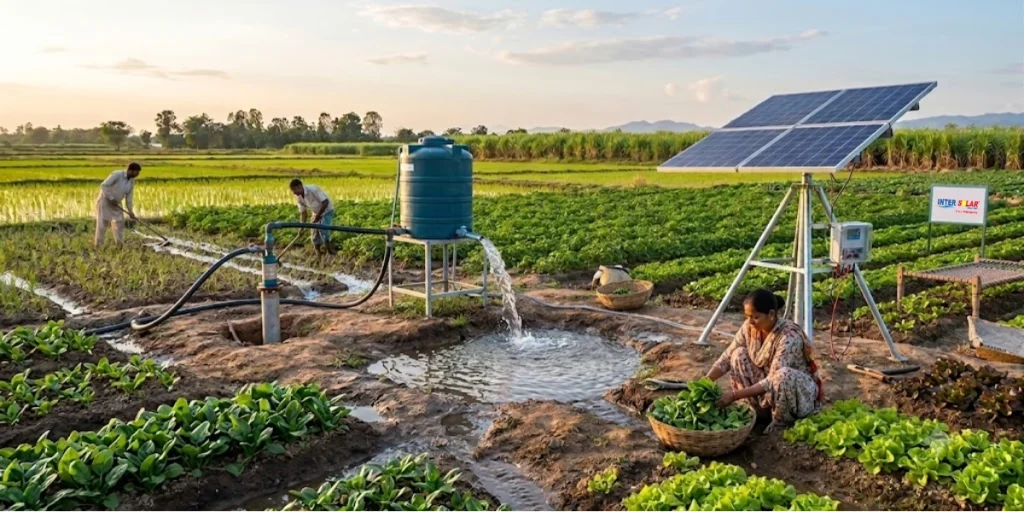
Inter Solar provides design and installation services of solar water pumping systems for their agricultural, commercial, and industrial customers all over India. Being among one of the reputed brands providing reliable Solar Water Pumping System solutions, Inter Solar ensures that the systems installed are durable and require minimal maintenance. They also help their clients in choosing government subsidy programs relevant to their projects. With strong after-sales support, Inter Solar is the best solar pump company in India for buyers who want dependable systems built to last.
Get a quote from Inter Solar today and start saving on your water pumping costs.
Conclusion
The solar pump provides you with an effective and economical solution to lift water for agricultural, residential, and industrial purposes. The solar pump reduces the cost of operation, requires very little maintenance, and is eligible for government subsidies too. In whichever sector you require solar pumps, whether agriculture or commercial, choosing the correct one is important. Request a call from Inter Solar to find the right fit for your land.
Frequently Asked Questions
Is a solar pump DC or AC?
Solar pumps come in both types. DC pumps connect directly to panels and suit smaller loads. AC pumps need an inverter and suit larger, higher-capacity irrigation needs.
Can a solar pump work at night or on cloudy days?
Not directly, unless it includes battery storage. Many systems add lithium batteries or a grid backup option for continuous supply.
How long does a solar pump last?
Most solar pumps last 10 to 20 years with proper care. Some well-maintained systems can run for over 30 years.