
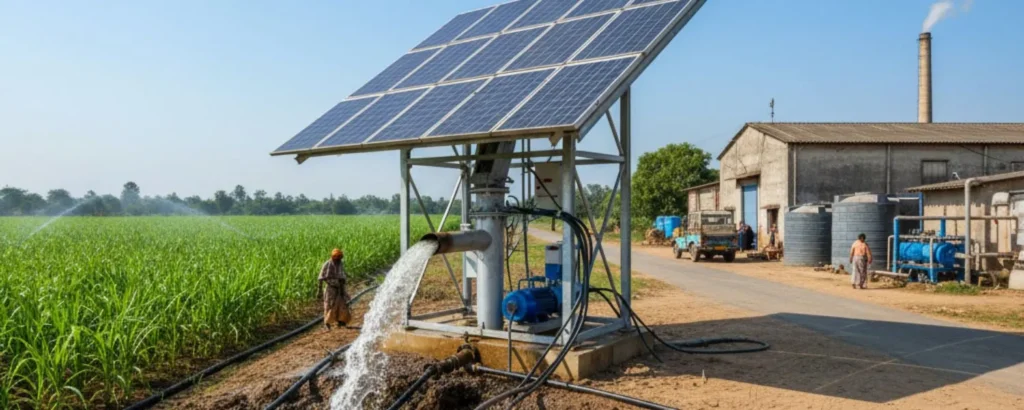
Water availability often decides the productivity of a farm field or an industrial facility. In a scenario of uncertainty of power supply, pumping water becomes costly and unreliable as the costs of operation continue to rise. This is where the Solar Water Pumping System provides a very viable alternative. By using sunlight as the main energy source, these systems provide consistency, cost control, and long-term reliability for agriculture and industries alike.
Solar-powered pumping is no longer an emerging idea across India. It’s shaping how farms irrigate land and even how businesses manage water-intensive operations.
How Solar Water Pumping System Works
The Solar Water Pumping System converts sunlight into electricity through solar panels, which in turn powers a surface or submersible pump. The system runs during the day and, if the site requires, can be equipped with controllers, storage tanks, or hybrid grid connections.
In addition, it means a natural alignment of water availability with irrigation schedules for agricultural users and continuity of water flow for cooling, cleaning, and processing for industrial users in areas where grid supply may be unstable.
Solar systems, unlike diesel-based pumping, reduce dependency on fuel logistics and recurring operation costs. Over time, this shift significantly improves financial predictability.
The Role of Solar Pumping in Indian Agriculture
Indian agriculture is confronted with two unwavering adversaries: inconsistent electricity and increasing fuel prices. A Solar Water Pumping System directly addresses both. Farmers gain independence from erratic power supply while reducing long-term expenditure.
Government initiatives like the agriculture solar water pump government scheme programs accelerated this even further. These schemes reduce upfront investments and motivate sustainable irrigation activities, especially in water-stressed regions.
Key advantages for agriculture include the following:
- Reliable access to water for drip and sprinkler irrigation
- Lower operational costs in comparison with diesel pumps
- Low maintenance required
- Reduced impact on the environment
With proper system sizing and professional installation, solar pumping allows for better crop planning and improves the yield stability over several seasons.
Solar Water Pumping for Commercial and Industrial Purposes
Water availability decides the productivity of commercial and industrial facilities. Be it a manufacturing plant, warehouse, or processing unit, disruption to the water supply causes delay and increases the costs of operation. The Solar Water Pumping System, integrated with Commercial and Industrial Solar Infrastructure, provides a workable solution to fulfil the demand for water with controlled energy expenses.
Dependable Supply of Water for Daily Needs
Water is needed in huge amounts and for various processes in most of the industries. A Solar Water Pumping System converts solar energy during peak daylight hours, reducing dependence on grid electricity and diesel. The purpose of this arrangement is to ensure that water would be available even when the power supply is unstable in that region and thus enable a business to plan better for continuity.
Scalable Systems with Ground-Mounted Installations
Many facilities opt for larger systems supported by EPC Ground Mount Solar Installation Services, especially where land availability is not a constraint. For the ground-mounted systems, panel orientation is easier and more possible for higher energy generation, hence making it easier to expand any capacity in the future. Access for maintenance is also simpler, reducing service time and the cost of upkeep in the long run. They have a very wide range of applications, going from commercial to industrial ones.
Various uses can be made of a solar water pumping system in these various sectors:
- Circulation of cooling water in manufacturing and industrial plants
- Water supply for industrial cleaning and sanitation processes
- Management of process water in food processing and textile facilities
- Utility water distribution for commercial buildings, warehouses, and institutional campuses
Role of EPC Expertise in System Performance
Design accuracy is vital to long-term efficiency. Seasoned EPC services providers would assess the water requirement, pump capacity, operating hours, and solar generation potential before finalizing the system layout. In this way, the solution would be designed to meet the realistic needs of operation rather than those projected on paper.
In collaboration with trusted EPC services providers and using proven EPC solar solutions in India, businesses can deploy Solar Water Pumping Systems that support their operational growth and energy efficiency, assuring dependability of water access into the future.
System Design and EPC Experience Matter
A solar water pumping system requires highly accurate design and quality installation. The calculation of various factors is highly required, like the depth of water, daily discharge requirement, amount of solar irradiation, and seasonal demand.
Professional EPC services providers appraise:
- Selection of pump type and capacity
- Solar array sizing
- Controller and inverter configuration
- Design of mounting structure
- Safety and compliance standards
This will ensure that the chosen EPC solar solution is reliable and operates to give expected output throughout the system’s lifespan, not only in the initial operation.
Maintenance and Long-Term Reliability
Low maintenance is one of the strongest advantages of solar pumping. However, routine checks remain very important to ensure consistent performance.
Scheduled support from solar power maintenance services in India includes:
- Cleaning of panels for sustained generation of energy.
- Electrical inspection of cables and controllers
- Checks on the performance of pumps
- Monitoring system efficiency
Preventive maintenance reduces downtime and improves return on investment, especially for commercial and industrial users operating at scale.
Cost Considerations and Return on Investment
Although the initial investment in a Solar Water Pumping System is higher compared to conventional pumps, the long-term economics are strongly in favour of solar. Savings come as a result of fuel and electricity bills that are eliminated, as well as the minimum servicing expenses. Commercial and industrial solar projects exhibit shortened payback periods more often due to the higher usage volumes and higher energy offsets. If subsidies, accelerated depreciation, or financing options are factored in, it makes solar pumping a financially sound infrastructure upgrade. Project developers and EPC contractors increasingly include solar pumping in integrated energy planning to strengthen overall project viability.
Sustainability Benefits Beyond Cost Savings
Solar pumping directly contributes to the sustainability of development. Reduced consumption of fossil fuels lowers emissions and noise pollution. To rural communities, it means a cleaner environment and better working conditions. For companies, transitioning to solar pumping reinforces ESG pledges while solidifying operational resilience. Sustainable water management is no longer a choice; it is a strategic imperative.
Making the Right Decision with Inter Solar
A Solar Water Pumping System is most effective when it is planned as part of a larger water and energy strategy, not treated as a standalone installation. Site conditions, operating cycles, and long-term water demand must guide every design choice. When these factors are addressed correctly, solar pumping delivers stable performance and predictable outcomes across agricultural, commercial, and industrial environments.
At Inter Solar System, we focus on engineering-led solutions that respond to actual field requirements. Each system is designed with attention to technical accuracy, integration with existing infrastructure, and long-term operability. This approach ensures solar water pumping remains reliable as operational needs evolve, rather than becoming a constraint over time.
Frequently Asked Questions (FAQs)
Key factors include water source depth, daily water requirement, pump capacity, available solar irradiation, land availability, and seasonal demand variations. Professional assessment by experienced EPC services providers ensures the system is sized correctly for long-term performance.
Yes. Solar water pumping is widely used in manufacturing units, warehouses, processing plants, and commercial campuses. When integrated with Commercial and industrial Solar infrastructure, it provides reliable water supply while reducing dependence on grid electricity and fuel.
Solar water pumps operate primarily during daylight hours. However, systems can be designed with storage tanks, hybrid grid connections, or backup solutions to maintain water availability during low sunlight or power disruptions.
Maintenance requirements are relatively low compared to diesel or grid-powered pumps. Regular panel cleaning, electrical inspections, and periodic pump checks, usually handled by solar power maintenance services in India, help maintain consistent performance and system longevity.
Return on investment depends on system size, usage intensity, energy costs offset, and available subsidies. In many agricultural, commercial, and industrial applications, payback periods improve significantly due to reduced fuel and electricity expenses and minimal operating costs.