
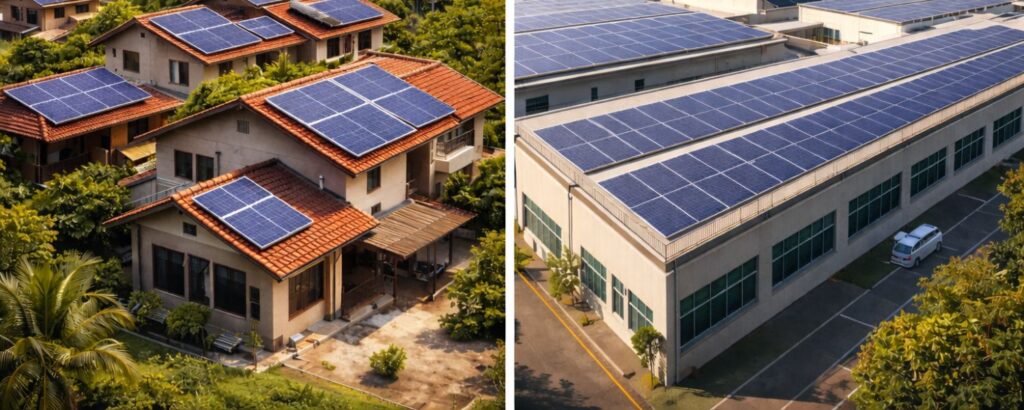
When you think about rooftop solar, the first image that might come to mind is a home with gleaming panels on the roof. But solar isn’t just for households anymore. Businesses, factories, schools, and almost every other type of institution use rooftop solar to cut costs and help power their operations in a sustainable manner. While both homes and businesses benefit from this, the systems can be considerably different. Let’s explore the real difference between rooftop solar for home vs business, and what makes each one suited to its particular purpose.
Why the Shift Toward Rooftop Solar?
Solar energy has turned out to be one of the most practical and reasonable energy choices in India. The rising electricity tariff and falling cost of solar installations have made both homeowners and enterprises rethink the way they consume power. Be it a family looking to save on monthly bills or a business trying to reduce its carbon footprint, solar proves to be a smart investment on both ends.
While the motivation might be essentially the same, in residential and commercial solar panel systems, design, scale, and output requirements differ widely.
1. Scale and Energy Demand
The most obvious difference between rooftop solar for home vs business lies in energy consumption.
Residential Solar Panels: The consumption of electricity in a house is considerably lower compared to offices or factories. For a small family, one may require a 3-10 kW system for daily usage of lighting, fans, kitchen appliances, and air conditioning.
Commercial Solar Panels: These are meant for commercial buildings and can involve machinery, elevators, cooling systems, lighting on different floors, and much more. These can easily range from 25 kW to several megawatts.
This difference in energy demand influences the system design, panel size, and even the number of inverters used.
2. Space and Roof Design
Not all roofs are built the same, and that reflects in how panels are installed.
Residential Systems: In the majority of residential systems, space is limited to smaller and angled roofs. Shading, the strength of the roof, and aesthetics are some of the key conditions that installers need to consider when placing solar panels.
Commercial Systems: Commercial establishments have flat or expansive rooftops, and it is very easy to install more panels in rows. This particular factor provides major advantages related to scalability and maintenance in commercial setups.
Simply stated, a warehouse roof can handle an enormous solar array, whereas the residential roof needs to focus on balance and aesthetics.
3. System Efficiency and Type of Solar Panel
Some of the main differences between residential and commercial solar panel systems are efficiency and design specifications.
Residential Panels: These are usually smaller 60-cell modules, easier to mount and service. Their primary focus is on long-term reliability, fitting seamlessly into limited roof space.
Commercial Panels: These are generally larger, using 72-cell or even 96-cell modules. These provide higher efficiency and more power per panel for high-energy operations.
Companies also invest in more sophisticated inverter technologies and monitoring systems for power generation at multiple facilities.
For more details about types of Solar Panels, you can check here – Solar PV Panel Types That Are In Demand
4. Installation and Cost
Cost is another big differentiator when it comes to rooftop solar for home versus business.
For Houses: Smaller residential solar systems are more affordable. Installation costs for such systems may range from ₹60,000 to ₹1.5 lakh per kW, depending upon the capacity and brand. Government subsidies for residential users are helpful in reducing the cost further and also make it more viable for homeowners.
For Businesses: Commercial systems require larger investments due to their scale. However, companies benefit from faster payback periods given the higher energy savings and tax benefits like accelerated depreciation. Many commercial users are also going for PPAs to help them cut down on the capital costs.
5. Ownership and Maintenance
Maintenance, while often overlooked, is not a less important issue than others when comparing residential to commercial solar panel systems.
Residential: Most homeowners are content with a simple setup that requires low maintenance, such as cleaning the panels a few times a year. Service contracts may be recommended, but are not required.
Commercial: However, businesses require professional maintenance contracts. With their systems being way larger, these have to be monitored for performance and cleaned regularly for output to remain consistent.
Advanced diagnostic tools in commercial settings ensure that system issues are detected right away, thus reducing any chances of downtime.
6. Financial Benefits and Policy Support
The government plays a strong leading role in making it easier for both homes and businesses to use solar panels.
Residential Incentives: Homeowners receive direct subsidies under the Rooftop Solar Programme and net metering, whereby surplus electricity can be sold back to the grid.
Commercial Incentives: While the same subsidy levels are not extended to commercial users, tax incentives and depreciation advantages make it very financially rewarding for the adoption of solar.
Both benefit from the lower GST rates on components related to solar, which makes installation cheaper.
7. Environmental and Brand Impact
For most homeowners, the switch to solar is deeply personal: to reduce their carbon footprint and save money. To businesses, it’s an environmental and strategic choice. By opting for solar power, a company signals responsibility, innovation, and long-term thinking. It reduces emissions, but also very significantly improves brand image in the eyes of customers, investors, and employees.
That’s why, to commercial entities, it’s part of a greater ESG, or Environmental, Social, and Governance goals, while residential users view this through a different lens: as a lifestyle upgrade.
Choosing What Fits You
So which one is better? It all depends on who is asking. If you’re a homeowner, solar is all about saving money, securing consistent power, and adding value to your property. But for a business, it’s all about energy independence, operational stability, and brand credibility. Both of these setups have the same objective-clean and reasonable energy-but differ in approach.
If you are considering rooftop solar either for your home or business, make sure you choose a reputable provider who has appropriate experience in each sector. At Inter Solar Systems, we offer high-quality installations and expert guidance tailored to fit the needs of either powering your home or an enterprise.
Start saving on energy costs today—discover how Inter Solar Systems can power your future with clean, reliable solar energy.
Conclusion
The rise of solar in India has marked a new turn in the way we perceive energy. As the costs of the panels continue to fall further and the technology gets efficient, the line between residential and commercial solar will continue to blur. Still, understanding these key differences helps ensure your system delivers the best performance and value for your specific needs. Whether you power your home or drive your business forward, the energy of the sun is ready for work; all you have to do is decide where to start.
Frequently Asked Questions
Both systems use similar photovoltaic materials, but commercial panels are typically larger and designed for higher energy output.
Technically yes, but it’s not practical. Commercial systems are heavier and require more space and capacity than most homes can handle.
Residential systems have a lower upfront cost, while commercial systems cost more but offer higher returns through energy savings and tax benefits.
Both residential and commercial solar systems generally last around 25 years with minimal maintenance.
Yes. While both can export excess power to the grid, commercial users often deal with different tariff rates and billing structures based on state policies.