
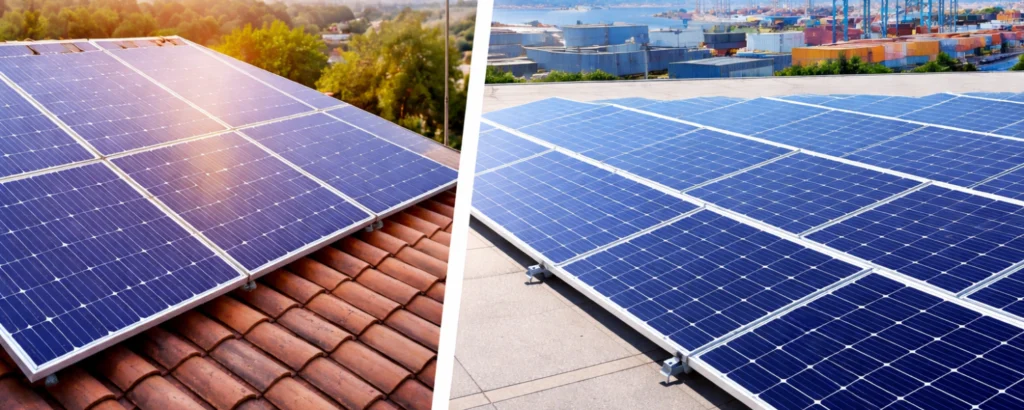
In Indian homes, rooftop solar has become a common topic. But as soon as someone decides to install a Solar PV Panel, another question comes up: DCR vs. Non-DCR Solar Panels. What makes them different, and does it really matter?
It matters because rooftop solar is no longer solely a technical choice in India. Which solar panel system to install and the level of support you get are now influenced by manufacturing regulations, compliance standards, and government subsidies.
In this blog, we will explore DCR vs Non DCR Solar Panels so that you can make an informed decision based on your project type, budget, and long-term goals.
What Are DCR and Non-DCR Solar Panels?
DCR Solar Panels
DCR stands for Domestic Content Requirement. This means that the solar cells and modules are manufactured in India as per the government guidelines under the Ministry of New and Renewable Energy. If the installation is being supported through a central programme, the Solar PV Panel usually needs to be DCR-compliant.
Non-DCR Solar Panels
Non-DCR panels include modules that use imported cells or are manufactured outside India. They are common, widely available, and used across private residential rooftops, commercial buildings, and industrial sheds.
If a project is not subsidy-linked, the buyer typically has more freedom. That is where Non-DCR options come into the picture.
So the difference is not “good vs bad.” It is more like “subsidy-friendly vs open-market flexible.”
Why the Indian Government Introduced DCR
India used to depend heavily on imported solar components. That kept prices competitive, but it also created a weak point. When international supply chains got messy, lead times shifted and pricing became unpredictable.
To reduce dependence and build capacity inside the country, the government pushed several measures, including:
- Production Linked Incentive schemes
- Basic Customs Duty on imports
- ALMM compliance rules
- Domestic Content Requirement for subsidy-linked projects
Together, these policies encourage local production and help strengthen the ecosystem around any Solar Panel Manufacturer India operating at scale.
For rooftop buyers, this policy environment affects what qualifies for support and what does not.
Key Differences Between DCR vs Non DCR Solar Panels
| Factor | DCR Solar Panels | Non-DCR Solar Panels |
|---|---|---|
| Manufacturing | Made in India | Globally sourced or imported |
| Subsidy Eligibility | Eligible for most Government subsidies | Not eligible for most Government schemes |
| Upfront Investment | Higher upfront costs due to domestic manufacturing | Usually lower upfront costs |
| Technology | Depends on domestic availability | Wider global options |
| Ideal For | Subsidy-backed residential rooftop projects | Commercial and industrial applications |
Which Solar PV Panel Is Better for Residential Rooftop Solar?
If You Are Applying for Government Subsidy
If the rooftop project is planned under a central subsidy framework, DCR compliance becomes the first filter. Without it, subsidy approval can get delayed or rejected.
In many homes, the slightly higher module price is balanced by the subsidy benefit. That is why DCR panels end up being a practical choice in subsidy-linked residential projects.
And yes, it often also means choosing from an approved Solar Panel Manufacturer India on ALMM, because documentation matters in these cases.
If You Are Installing Without Subsidy
If there is no subsidy, the roof becomes a more open marketplace.
Then the comparison shifts to:
- Price per watt
- Expected output in your climate
- Technology type (Mono PERC, bifacial, etc.)
- Warranty strength
- Service and replacement support
For a homeowner installing a solar PV panel in India, the better option is the one that fits the budget and gives reliable service locally.
That last part matters more than most people admit. A panel can be brilliant on paper, but if support is weak, the experience becomes frustrating.
Performance: Is There a Technical Difference?
A common assumption is that DCR panels underperform compared to imported panels. That used to be a popular talking point. Today, it is not a fair generalisation.
There are strong solar panel companies in India that manufacture efficient modules across Mono PERC, bifacial, and newer technologies.
Actual performance depends more on:
- Cell design
- Consistency of manufacturing
- Temperature behaviour in Indian summers
- Installation quality and shading control
A good DCR-compliant Solar PV Panel can absolutely match output and reliability expectations when sourced from a credible manufacturer.
At rooftop scale, installation design often affects output more than the DCR label.
When Should You Choose DCR Over Non-DCR?
Here is a simple breakdown to help you make a decision:
Choose DCR if:
- The project is subsidy-linked
- Compliance must be clean and straightforward
- Documentation matters for approvals
- Local sourcing is preferred
Choose Non-DCR if:
- The project is fully private
- No subsidy is involved
- You want a wider technology choice
- You are trying to reduce the upfront cost
In most subsidy-backed residential projects, DCR is required anyway, so the debate ends quickly.
In private projects, it becomes a real decision. That is where buyers should focus on service support and installation quality, not just module origin.
Common Myths About DCR vs Non-DCR Solar Panels
Myth 1: DCR panels are automatically lower efficiency.
Efficiency comes from technology and manufacturing quality, not a DCR tag.
Myth 2: Non-DCR panels are “not allowed” in India.
They are widely used in private and commercial installations.
Myth 3: Subsidy always makes DCR cheaper overall.
Not always. It depends on tariffs, system size, and the final quote.
Myth 4: Imported panels are always superior.
Quality varies globally, too. Brand and test standards matter more.
Final Thought
The DCR vs Non DCR Solar Panels question often sounds like a technology debate, but it is mostly a project-type decision.
If a subsidy is involved, DCR compliance is usually required. If it is a private project, your choice can be based on cost, performance, and the Solar Panel Manufacturer India that provides good support services.
The best time for a rooftop Solar PV Panel is when all factors are in place: policies, costs, roof suitability, and practical energy demand.