
In 2026, solar panel price in India range from roughly ₹60,000 for a 1 kW system to ₹6.5 lakh for a 10 kW system, before subsidies. A 3 kW rooftop setup, the most popular home size, typically costs ₹1.60 lakh to ₹2.25 lakh before the government’s ₹78,000 support kicks in.
Factors such as your city, brand, wattage, and panel type determine how much you’ll pay. Fortunately, with an understanding of the per-watt math and the individual components of the solar panel installation costs, it becomes easier to compare different offers.
Key Takeaways
- 1 kW solar system: ₹60000 to ₹85000 (before subsidy) ₹25000 to ₹50000 (after subsidy)
- 2 kW system: ₹1 lakh to ₹1.5 lakh without subsidy, ₹40,000 to ₹90,000 with subsidy.
- 3 kilowatt solar panel price runs from ₹1.60 lakh to ₹2.25 lakh, dropping to under ₹1.5 lakh after subsidy.
- System of 5 kW: Costs around ₹2.80-3.40 lakhs, subsidy being limited to ₹78,000.
- System of 10 kW: Costs around ₹5.20-6.50 lakhs, subsidised up to ₹78,000.
- Price of solar modules ranges from ₹18 to ₹35 per watt depending on technology.
- DCR panels are more expensive and are the only ones eligible for subsidy.
- Solar battery price for lithium models runs from ₹20,000 to ₹35,000 per kWh.
Solar Panel Price in India: The Size-Wise Table
Here is a clean snapshot of what Indian homeowners are paying in 2026. Treat it as a planning anchor, not a fixed quote.
| System Size | Cost Before Subsidy | Central Subsidy | Cost After Subsidy | Roof Area Needed |
|---|---|---|---|---|
| 1 kW | ₹60,000 – ₹85,000 | ₹30,000 | ₹25,000 – ₹50,000 | 80–100 sq. ft. |
| 2 kW | ₹1.00 – ₹1.50 lakh | ₹60,000 | ₹40,000 – ₹90,000 | 160–200 sq. ft. |
| 3 kW | ₹1.60 – ₹2.25 lakh | ₹78,000 | ₹85,000 – ₹1.47 lakh | 240–300 sq. ft. |
| 5 kW | ₹2.80 – ₹3.40 lakh | ₹78,000 | ₹2.02 – ₹2.62 lakh | 400–500 sq. ft. |
| 10 kW | ₹5.20 – ₹6.50 lakh | ₹78,000 | ₹4.42 – ₹5.72 lakh | 800–1,000 sq. ft. |
Notice the subsidy stops growing after 3 kW. That single fact confuses a lot of first-time buyers. Moreover, central assistance under PM Surya Ghar caps at ₹78,000, no matter how large your rooftop plant gets.
What Is the 1 kW Solar Panel Price, Really?
A 1 kW solar panel price sits between ₹60,000 and ₹85,000 for a complete, installed system. The solar panels for home cost includes solar panels, an inverter, wiring, and the structure itself. After getting a central subsidy of ₹30,000, the remaining cost is ₹25,000 to ₹50,000 for most families. Moreover, this is good for households with lights, fans, a refrigerator, and a TV. It produces around 4-5 units of electricity per day. It cannot run heavy electrical equipment such as air conditioners and geysers.
Why Does a 3 Kilowatt Solar Panel Price Vary So Much?
It may be possible for two installers to charge a difference of ₹40,000 for installing the same 3kW system and yet remain honest. The cost of the 3-kilowatt solar panel depends on the quality of the inverter being used, the quality of the structure, and the length of wire involved. A hot-dip galvanised structure is more costly than a mild steel painted structure but is durable. The technology of the panels also plays a part. Mono PERC helps to keep costs down, while TOPCon increases efficiency. For a closer fit on the roof, make sure you ask what is not included in the quotation.
Solar Panel Price Per Watt: The Technology Breakdown
Buyers often compare panels using rupees per watt. This table shows where the 2026 module pricing sits by technology.
| Panel Technology | Price Per Watt | Typical Efficiency |
|---|---|---|
| Mono PERC | ₹18 – ₹26 | 20–21% |
| TOPCon (N-Type) | ₹20 – ₹28 | 22–23% |
| Bifacial | ₹24 – ₹35 | 21–23.5% |
These are just estimates for the modules alone. When calculating the total cost for the installation of solar PV panels for residential purposes, there is an additional cost that includes the inverter, mounting, cables, earthing, and labour. The cost of the panels usually forms fifty percent of the total cost.
DCR vs Non-DCR: The Choice That Affects Your Subsidy
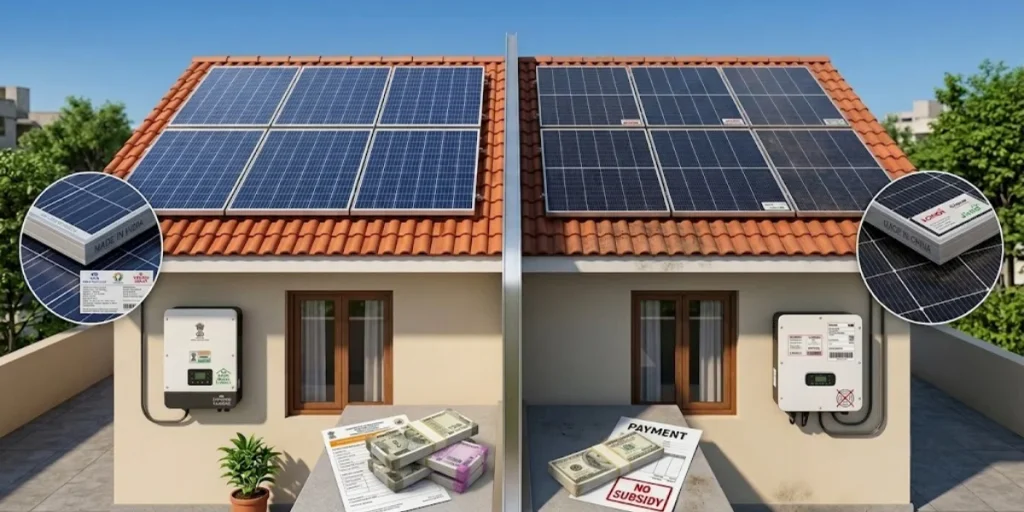
This is a bit confusing but makes all the difference if one wants any government subsidy at all. DCR panels utilise solar cells manufactured in India. Non-DCR panels utilise imported cells, mostly from China. Only DCR panels qualify for the PM Surya Ghar subsidy scheme. Non-DCR panels appear more economical than DCR panels by ₹6,000 to ₹12,000 for a 3 kW plant.
However, using non-DCR panels means losing out on up to ₹78,000 in subsidy, which almost never works in favour of domestic household rooftops. Additionally, this became even stricter from June 2026 with ALMM List-II.
What Is the Solar Battery Price in India?
Most cost guides skip this entirely, yet batteries change your total bill significantly if you want backup power. Solar battery price depends heavily on chemistry.
| Battery Type | Approx. Price Per kWh |
|---|---|
| Lead-Acid | ₹8,000 – ₹15,000 |
| Lithium Iron Phosphate (LFP) | ₹20,000 – ₹35,000 |
Lead-acid is less expensive to buy but needs replacement after 3-4 years. LFP is more expensive but lasts for more than 4,000 cycles, making it more economical over 10 years. However, it is important to note that the subsidy scheme of PM Surya Ghar is applicable for grid-tied systems only.
What Factors Affect Solar Panel Installation Cost?
There are various factors that make your quotation high or low. Knowing about them enables you to understand how the quotation works.
- Type of panel: TOPCon and bifacial panels are more expensive than regular Mono PERC panels.
- Inverter brand and type: On-grid, hybrid, and off-grid inverters are priced quite differently.
- Structure of the roof: Metal sheds are cheaper than RCC structures for mounting.
- Cable length: Longer wiring between the inverter and the meter requires additional copper.
- City and location: Labour and transportation charges vary from state to state.
- Warranty length: Stronger product and performance warranties raise the upfront price slightly.
Make sure that quotes are based on the same coverage. Low cost in installing solar panels may indicate no earthing, no protection, and a lack of documentation.
Hidden Costs Nobody Mentions After Installation
Cleaning of solar panels should be done once every one to two months, particularly in dusty places. Inverters last between eight and twelve years and thus would have to be replaced within that period, whereas panels can last much longer than inverters. One would need to spend between ₹25,000 and ₹65,000 for inverter replacement.
The annual maintenance cost amounts to just a few thousand rupees. All this may not be costly alone, but if you skip doing this, it will gradually eat away at your savings.
Which Solar Panel Manufacturer in India Should You Choose?

Price should not be the only factor influencing your decision. A trustworthy solar panel manufacturer in India guarantees a 25-year performance warranty for their solar panels. Hence, always go for manufacturers that have a genuine factory infrastructure rather than trading operations. Inter Solar has been manufacturing solar PV panels since 1997, alongside heat pumps and solar water heating systems for Indian homes. Therefore, understanding how rooftop solar panels work in India also helps you judge whether a quoted system size actually fits your household load.
Final Words
Solar panel prices in India 2026 range from ₹60,000 for 1 kW to ₹6.5 lakh for 10 kW, before subsidy. The technology of solar panels, whether the property is DCR, the quality of the inverter, and the site location will all affect the cost of solar panels. Therefore, it is always advisable to compare complete system rates and see if you are eligible for PM Surya Ghar Yojana. So, get a quote from Inter Solar Systems to find a system suited to your roof, electricity use, and budget.
Frequently Asked Questions
Will my solar panels power my home during a power cut?
Usually, no. A standard grid-connected system shuts down when the grid fails, even if the panels are receiving sunlight. If backup power matters to you, ask the installer for a system designed to operate during outages and get its battery and inverter costs in a separate quote.
Can I install solar panels on a roof that gets some shade?
Yes, but shade can reduce electricity generation and affect the savings estimate. Ask the installer to assess shadows from nearby buildings, trees, and water tanks throughout the day before recommending a system size.
What should a solar installation quotation include?
Ask for an itemised quote covering the panels, inverter, mounting structure, wiring, electrical protection, installation, taxes, and any meter-related charges. It should also state the equipment models, warranty terms, and estimated annual generation. That makes two prices easier to compare than a single “cost per kW” figure.
Does a commercial 10 kW system qualify for the ₹78,000 PM Surya Ghar subsidy?
The residential consumer subsidy should not be applied automatically to a commercial installation. If the 10 kW quote is for a business, confirm the applicable scheme and eligibility with the installer and your DISCOM before subtracting any subsidy from the price. The article’s “cost after subsidy” table should be labelled for eligible residential installations.