
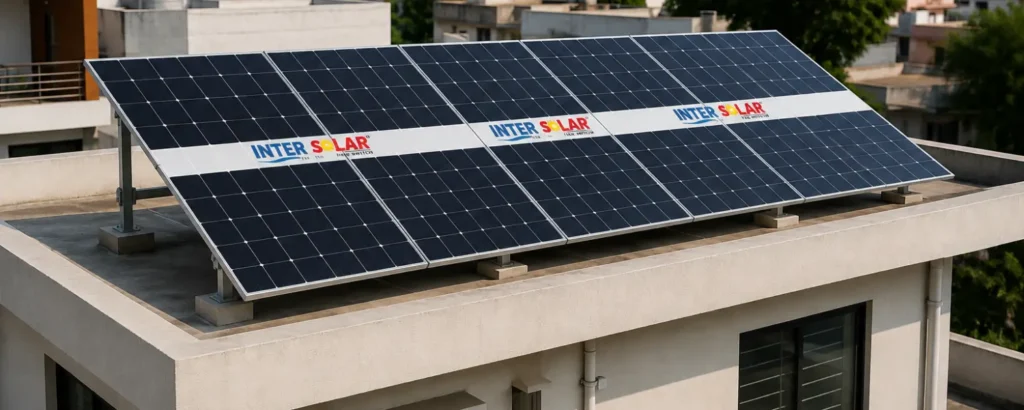
Rising home electricity bills are a serious concern for most Indian households, especially when the AC or geyser works daily. But there is some good news: a home solar panel system can cut your monthly bills by generating power throughout the day.
The installation of solar PV panels can reduce grid dependence by roughly 80% to 90%. However, reducing the home electricity bill largely depends on usage patterns and hours of daylight.
Government subsidies, net metering, and declining equipment prices have made it one of the smartest ways to reduce costs. Below is all you need to know about saving money on your electric bills with solar power.
Key Takeaways
- Since solar panels generate electricity using sunlight, you will consume less electricity from the grid, which saves money on your monthly bills.
- An average of 3-5 kW system of solar panels at home can produce between 12 and 20 units of electricity per day, which is sufficient for household use.
- As part of the PM Surya Ghar Muft Bijli Yojana scheme, households can benefit from subsidies worth Rs 78,000 and receive up to 300 units of free electricity per month.
- Net Metering is an option that allows you to send any extra electricity generated by your solar panels back to the grid for credits, and thus reduces the home electricity bill unit price further.
- Selecting panels of a reputable solar manufacturing company in India helps ensure better performance and fewer frequent malfunctions.
- Utilising energy-efficient appliances along with solar energy, like 5-star inverters, allows you to save more money.
Why Your Home Electricity Bills Keep Rising
Before opting for solar energy, it’s best to know why your bills are rising continually. In India, the cost of electricity is calculated using a slab rate, which means that the higher your consumption, the higher the price of electricity per unit.
In general, the rate of power consumption per unit ranges from ₹3 to ₹8 across all over India, which may further go up during the summer months due to the usage of air conditioners/coolers. With the increasing price of fuel and power transmission charges, it’s not surprising that most households are now considering ways to save on electricity bills.
How Solar Power Panels Actually Cut Your Bill
The process of a home solar power system is not very complicated. The installation of solar PV panels on your rooftop utilises the sun’s rays to generate power for your fans, lights, refrigerator, and other appliances.
Rather than purchase all of your units from the grid, you will be able to produce your fair share, which is precisely how you save on your electricity bill. Now here’s how it works:
- An average 3-5 kW residential solar system generates an estimated 12 to 20 units of electricity every single day. It is sufficient to cover most of the daily electricity usage.
- Most utility companies impose increased charges during peak hours. Using solar energy during the daytime avoids such expensive rates.
- All the extra units of electricity generated by your home solar PV panels go back into the electrical grid. You get credits for these units that reduce your home electricity unit cost.
- After installation, the solar power panels continue producing energy without any operating costs. Hence, you won’t be affected by any future hikes.
- High-quality solar panels usually last for 25 to 30 years with very little maintenance required.
Steps On How To Reduce Electricity Bill at Home With Solar
For those who are looking forward to saving on their home electric bill, below are some practical tips:
- Assess your roof and sunlight availability. Solar panels will produce the most energy when your roof faces south, and there is no shade.
- Choose the appropriate size of the solar panels. When installing your solar PV panels, it is better to go with the “20% rule.” It implies that your solar panels should produce 20% more energy than the usual daily consumption of electricity.
- Purchasing a solar panel from an established company will ensure that you get panels with higher efficiency ratings, proper warranties, and minimal repair requirements.
- Check whether you fall under the umbrella of the PM Surya Ghar Muft Bijli Yojana program before you finalise on the vendor. This subsidy will help in lowering your initial cost substantially.
- Connecting your solar panel installation at home with 5-star ACs, LEDs, and inverters will result in exponential cost savings per month.
- Make sure to check daily energy generation through your inverter app, and clean your panels every few months to maintain consistent performance.
Government Support: PM Surya Ghar Muft Bijli Yojana
The rooftop solar plan introduced by the Central Government helps make solar installation very cost-effective for Indians. Through this scheme, homeowners receive a direct subsidy that significantly brings down the installation cost of the system. Additionally, they get a maximum of 300 units of free electricity each month, depending on the size of the system.
1) Up to 2 kW: Subsidy of Rs. 30,000 per kW
2) For the 3rd kW: Extra subsidy of Rs. 18,000
3) Maximum subsidy: Rs. 78,000 for solar panel capacity greater than 3 kW
The subsidy amount will be directly deposited into your bank account after completion of the installation and grid connection process.
Comparing Grid Power and Solar Power for Your Home
|
Factor |
Grid Electricity |
Home Solar Panel System |
|
Source |
Purchased directly from the utility |
Self-generated power from sunlight through solar PV panels |
|
Monthly Cost |
Depends on slab-based tariffs |
Electricity bills get reduced significantly |
|
Effect of Tariff Hikes |
Bill rises with every hike |
Doesn’t affect as much |
|
Government Support |
None specific |
Subsidy up to ₹78,000 plus 300 units |
|
Lifespan of Investment |
Ongoing monthly expense forever |
High-quality panels can last up to 25-30 years from just one investment |
|
Environmental Impact |
Higher carbon emissions |
Minimal and clean energy generation |
Choosing the Right Solar PV Panels and Manufacturers
Solar panels do not offer the same level of performance. There are differences in the efficiency, quality, and services offered by the different solar power panel manufacturers. Hence, it is advisable to do research about your solar PV manufacturing company before you choose one. It is important to choose solar panels that have undergone testing in the Indian climate and to give preference to companies empanelled under the schemes of the government.
Conclusion
Solar is not just an environmentally friendly option but a very sensible one that will help you save money on home electricity every single month. Thanks to reduced costs of technology, net metering benefits, and the PM Surya Ghar scheme, Indian families can be able to pay back the initial cost within a few years and then live almost free of any electricity bills for many years to come.
FAQs
- Will solar panels reduce my electricity bill?
Yes. The solar panels produce energy during the daytime, that reduce the usage of electricity from the utility grid. In addition to that, the net metering system and initiatives such as PM Surya Ghar offer up to 300 units of electricity for free, which is an added advantage. - What is the 20% rule for solar panels?
This is a sizing rule that recommends that the capacity of your solar system should be able to generate 20% more energy than your daily consumption. This ensures that even on days when the sun does not shine, you have enough energy. - What is the Modi scheme for solar panels?
It is the “PM Surya Ghar Muft Bijli Yojana,” which was launched in February 2024. It provides a subsidy of up to ₹78,000 per household (₹30,000 per kW on the first 2 kW of power and ₹18,000 for the 3rd kW), along with 300 free electricity units per month. - How much AC bill for 1 hour?
The energy consumption per hour for a 1.5-ton AC is about 0.8 to 1.8 units, depending on the star rating. Assuming the cost per unit is about ₹7, then the total cost per hour would be around ₹6 to ₹13. - Which AC consumes the lowest electricity?
The 5-star inverter AC requires the least electricity, usually between 0.8 and 1.2 units per hour for 1.5 tons of AC. It uses less electricity compared to the 3-star non-inverter AC, which utilises 1.5 to 2 units of electricity per hour.