
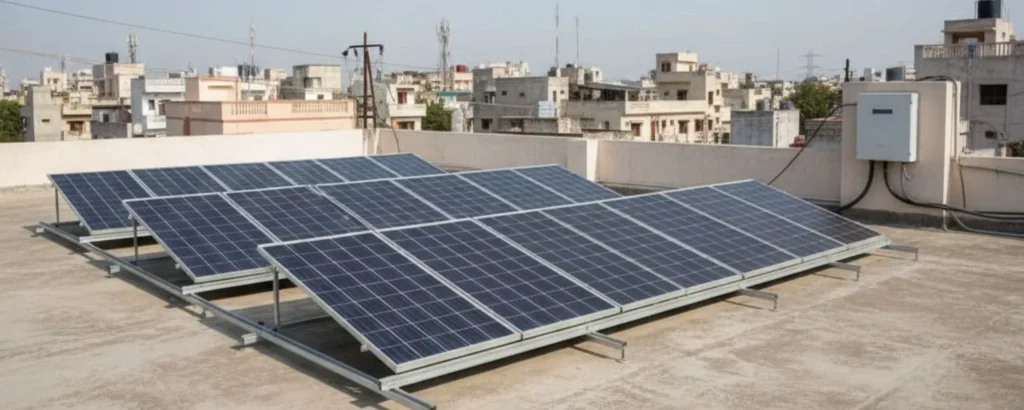
With the increasing cost of electricity, there is a rising number of households that are considering rooftop solar panels for their homes. They weigh solar power installation for the home to be more of a necessity than a fancy idea.
However, the first question that comes to everyone’s mind is, “How many solar panels are required for a 3BHK house?” And to answer – It depends on various factors such as usage pattern, roof orientation and condition, and geographical location. So, if you are also planning for a rooftop solar panel installation and have the same question, you have landed at the right place.
How Much Electricity Does a 3BHK Home Consume?
Before calculating the size of a solar system, it is important to know your power usage. An average Indian house, 3 BHK, consumes between 300 and 600 kWh of power each month. It depends largely on the number of people living and the electrical appliances used.
The following is a rough monthly breakdown of power usage by common household appliances:
| Household Appliance | Units of Electricity Used |
| Air Conditioner (1 to 2) | 120 to 250 Units |
| Refrigerator | 30 to 50 Units |
| Washing Machine | 15 to 30 Units |
| Lights and Fans | 50 to 100 Units |
| TV and Electronics | 30 to 60 Units |
| Kitchen Appliances | 50 to 80 Units |
| Total Electricity Consumption | 300 to 600 Units Per Month |
If you use more air conditioning and electrical equipment of high wattage, then your need for the capacity of solar energy will increase. You should look into your electricity bills of the past year, take their average, before solar power installation for home.
What System Size Does a 3BHK Home Need?
Once you are aware of your monthly power consumption, you can further calculate the solar system capacity required. A general thumb rule is that a “1 kW solar system generates approximately 4 units of power per day.” Monthly, the electricity generation is about 120 units, where there are 4 to 6 peak sunlight hours.
On the same basis:
- A 3 kW system is sufficient for a low-power consumption household that requires 300 units monthly.
- For a moderate consumption of 400 to 500 units of electricity in a month, a 4 kW system works efficiently.
- In case of high power consumption of 600 units or more in a month, a 5 kW system is advisable.
In India, most 3BHK homes fall under the category of 3 kW to 5 kW for a rooftop solar panel for a home.
Factors That Influence Your Exact Solar System Requirement
It is important to understand that no two 3BHK homes are alike. Their power needs, geographical location, roof space, everything is different. More such differentiating factors that influence the solar panel requirements are:
1) Location and Sunlight Availability: In India, states like Rajasthan, Gujarat, Maharashtra, and others receive more peak sunlight hours throughout the day. This allows the installation of small solar systems to generate more power. Whereas, coastal and north-eastern states require larger panels for more electricity generation.
2) Roof Orientation and Shading: It is a well-known fact that south-facing rooftops receive the most sunlight throughout the year. Also, homeowners should look out for partial shading from adjacent buildings or trees, as 10% of shade can cause a loss of 50% in the solar PV panels’ performance.
3) Appliance Efficiency: The houses that have inverter ACs, a 5-star refrigerator, or LED lights require lower amounts of electricity. When combined, this leads to a lower burden on the solar power system without affecting the energy requirements.
4) Future Upgradation Plans: Thinking about adding an extra AC, an EV charging station, or a geyser? Consider home solar power plant installation soon. Yes, solar systems have modularity, but it’s easier to plan them.
Choosing the Right Type of Solar System for Your Home
When planning a rooftop solar panel for a home, the type of inverter matters as much as the number of panels.
- On-Grid Systems: They are connected to the electricity grid, which makes them one of the most cost-effective options. It allows exporting the remaining power through net metering. (Net Metering: The surplus electricity generated by the solar system is sent back to the grid. This offsets your electricity bills and earns you credits.)
- Hybrid Systems: This system combines a grid connection with a battery backup. It is ideal for households that face frequent power outages but want an uninterrupted supply throughout the night.
- Off-Grid Systems: Off-grid solar systems do not depend on electricity and use batteries. They are more expensive than other solar systems.
Most Indian households prefer an on-grid system with a 3 kW to 5 kW capacity for their homes. Also, they offer the best return on investment.
Cost and Government Subsidies
A 3 kW home solar power plant in India costs between ₹1.5 to ₹2.2 lakh. However, this quote is before the government subsidy support. The Government of India’s PM Surya Muft Bijli Yojana offers an incentive of up to ₹78,000 and above for 3 kW or larger systems. This reduces the initial upfront costs of installation.
A 5 kW system costs somewhere between ₹3 and ₹4 lakh, which includes the cost of the inverter, mounting structure, panels, and others.
Most homeowners recover their investment within the time frame of 4 to 6 years that makes their electricity free for the next 15 years or more. If monthly savings are taken into account, it starts from ₹3,000 and touches up to ₹6,000, depending on the system size.
Tips to Maximise the Efficiency of Your Solar Setup
- Ensure that solar panels should be south facing for maximum power output annually.
- Panels should be cleaned regularly, especially before and after the monsoon season.
- Use energy-efficient home appliances like a 5-star refrigerator to reduce the overload.
- Consider including a solar water heater that can reduce your main electricity load even more.
- Checking your solar system’s performance through the app provided by your installer can help you track everything.
Conclusion
Investing in a rooftop solar panel for a home is one of the wisest long-term decisions you can take as a 3BHK homeowner in India. How? Because it will be cost-efficient and environmentally friendly. In fact, the government subsidies will allow falling panel prices and faster ROI, proving to be sustainable for your home and future.
FAQs
Q1. What is the 120 rule for solar panels?
The 120 rule is an electrical safety guideline. According to this rule, a 1 kW of solar panels generates around 120 units of electricity per month. Now, this estimated monthly output is influenced by the peak sun hours per day.
Q2. Does rain affect solar panels?
No, rains don’t damage the solar PV panels because they aid in washing away accumulated dust and debris from the surface. Cleaned panels give better energy output. However, the heavy monsoon season can reduce the final power generation for that duration.
Overall, solar panels are designed and engineered to withstand harsh climatic conditions like rain, hail, or humidity. High-quality panels from a reputed solar panel manufacturer in India have an IP67 or higher rating, making them suitable for all Indian weather conditions.
Q3. Can I run a 1.5-ton AC on solar?
Yes, a 1.5-ton AC can run on a solar power system. Typically, one AC can run comfortably for 8 hours with other electrical appliances on a 3 kW or 4 kW system. If you have an inverter AC, then it will use around 0.9 to 1.1 kW.
Q4. How many ACs can a 3 kW solar system run?
A 3 kW solar system generates 12 to 15 units per day. It can comfortably run one 1.5 ton inverter AC with other electrical home appliances. Also, running two ACs together on a 3 kW is not advisable. However, a 5 kW system can adjust the working of two ACs simultaneously.