
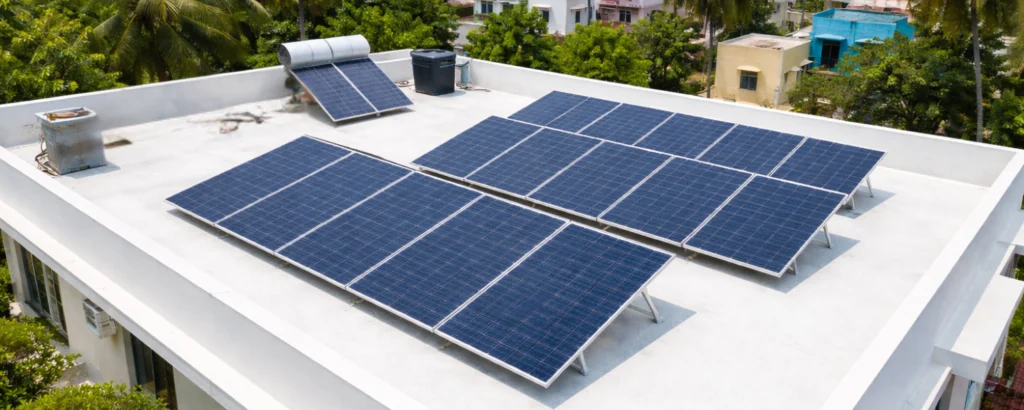
Before getting in touch with any leading solar panel manufacturer in India, it is important to evaluate your roof! Check whether your roof has enough space for solar pv panels installation. To put it simply, the size of the roof directly influences the number of panels that it can fit in. Larger the surface of the roof, more will be the number of panels installed and more will be power generation.
Why Roof Space is Important for Solar Panels Installation
Pre-evaluation of roof space before solar panel installation is essential because it requires direct sunlight to function. Every square foot of the roof represents the potential energy generation. Having a roof alone is not enough to get solar energy at home.
Nearby buildings, shade areas, and other instructions from chimneys, AC vents, and skylights limit the possible space. That’s not it! Even the tilt, orientation, and pitch of the roof impact how much useful space for panels is available.
Space Requirements by System Type Solar Panel in India
For every varied size and type of system space, requirements are different. It means that installation prerequisites will alter for a small house, large commercial spaces, or industrial facilities. Let’s look at these requirements individually.
Residential Solar Requirements
|
Approx. Area Requirement (Sq. ft.) |
System Capacity |
Best Suited For |
|
80-100 |
1 kW |
Small households that require less power or don’t rely too much on backup. (1 BHK) |
|
250-300 |
3 kW |
Medium households where there are 3 to 5 members in the family. (2-3 BHK) |
|
500 |
5 kW |
Big households with higher dependence on electrical appliances with considerable loads |
|
1,000 |
10 kW |
Very large or luxury homes that have 7 to 8, or more huge rooms with consistent energy requirements |
Commercial Solar Requirements
Commercial buildings such as office spaces, warehouses, and retail outlets have larger and flatter roofs. This kind of roof space is promising for higher-capacity and power-generating solar panel systems. Its capacity requirements start from:
- 10 kW System: 1,076 sq. ft. (100 sq. m)
- 50 kW System: 5,382 sq. ft. (500 sq. m)
- 100 kW System: 10,764 sq. ft. (1,000 sq. m)
Industrial and Large-Scale Requirements
Industrial solar installations need systems in the hundreds of kilowatts or megawatts. In case the roof space is insufficient, solar panels are mounted in the open ground spaces. They are:
500 kW systems work in 53,820 sq. ft, followed by a 1 MW system in 107,640 sq. ft and a 5 MW system for spaces that are or go beyond 12.35 acres.
Key Factors Affecting Space Needs
For choosing the appropriate roof for solar panel installation, there are other important factors to consider.
1) Panel Efficiency: Highly efficient panels from the best solar manufacturing company in India have more wattage in the same panel size. One of them is N-type TOPCon. This means that your daily energy requirements are met with a lesser number of panels and a smaller amount of space.
2) Roof Characteristics: It basically means, “How is the roof?” South-facing roofs are equipped for maximum sun exposure. Also, a flatter roof offers flexible panel placement but needs more space between two rows to prevent the chances of shading.
3) Gap Spacing: Panels require spacing between them for proper ventilation and mounting. The appropriate space needed is less than half an inch.
4) Walkways: Code building requires setbacks or obstruction-free paths to maintain safety on the edges.
How to Calculate Roof Area for Solar PV Panels?
For accurate determination of roof space, follow these steps carefully.
- Determine Daily Usage: Every individual’s energy needs are different. So, find your average daily power consumption in kWh from the electricity bills.
- Note Peak Sun Hours: Your solar PV panels will work under the sun, so calculate the average number of peak sun hours in a day. If you record 4 to 6 hours per day, you are good to go!
- Calculate System Capacity: To calculate this, all you need to do is divide your daily energy usage by the number of peak sun hours. What you will get is the required kW for your system.
- Choose Panel Wattage: Again, divide your system capacity by the wattage of the chosen panel for your roof space. This will help you in getting a number for the number of panels needed.
- Calculate Total Area: Multiply the number of panels by the average square footage of each panel. It should typically range from 17.5 to 20 sq. ft. per panel.
After following these steps, you can conclude whether your roof can accommodate the number of panels you need to meet daily power needs.
Alternatives for Limited Roof Space
Your dream of an energy-saving and eco-friendly household is not impossible. So, don’t feel disheartened if your roof space is small or structurally not solar-accommodating. You still have several options. They are:
1) Ground-Mounted Systems: Ground-mounted solar systems offer flexibility in solar placements in open areas of the house.
2) Solar Carports and Pergolas: These structures have a dual function of offering shade for vehicles along with power generation.
3) High-Efficiency Panels: Urban rooftops are limited and need high-efficiency monocrystalline panels to maximise energy production.
Final Words
What you need to understand is that the minimum roof space depends on your energy requirements. Additionally, type of system, panel efficiency, roof characteristics, and local climatic conditions also decide the required roof area.
Hence, if you are considering making a switch to a solar panel system for your household, it is important to reach out to a trusted solar panel manufacturer in India. Together, this will save you some money and reduce carbon footprints, too. (Something really worthy!)
FAQs
Q1) Can I run 2 ACs on a 3 kW solar system?
No, running two ACs on a 3kW system is not recommended. Usually a 3 kW system generates enough energy for one 1.5-ton inverter AC along with other electrical appliances.
Q2) What is the best roof for solar panels?
Solar panel installation is possible on various types of roof shingles. However, the most suited one is asphalt-shingled roofs.
Q3) Which side of the roof is best for solar panels?
A south-facing roof with no shade and peak sunlight works the best for solar panels. East- or west-facing roofs still work with 15 to 20% less efficiency. But north-facing roofs should never be considered.
Q4) Why do solar panels have to be on the roof?
Solar panels are usually installed on roofs because roofs get direct sunlight and offer free, unused space. They help generate clean electricity, reduce power bills, and lower dependence on the grid.
Q5) What is the purpose of roof anchoring in solar installation?
Roof anchoring or mounts support solar PV panels to ensure long-term stability. It also helps the system to withstand harsh climatic conditions, increasing its lifeline.