
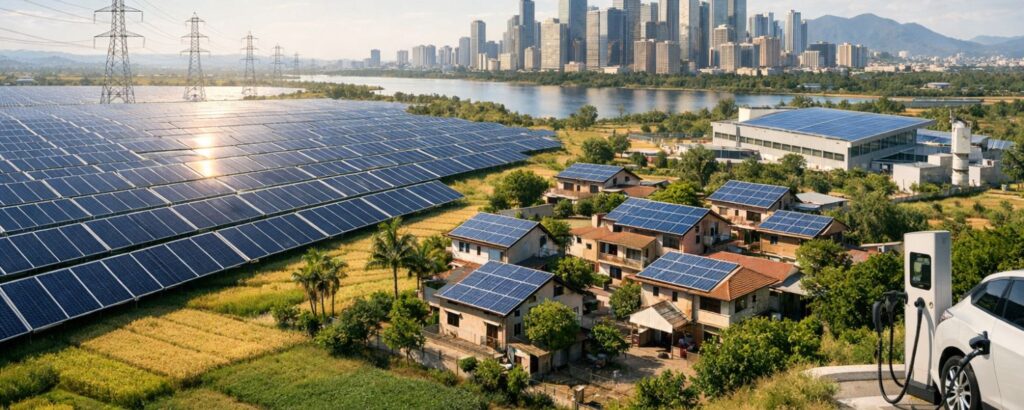
India is in the middle of a major energy shift. The demand for solar power in India has grown faster than most experts predicted, and you can feel it everywhere. From apartment rooftops in cities to utility-scale plants in semi-arid regions, solar adoption has moved from an alternative choice to a mainstream necessity. Rising electricity needs, falling equipment costs, stronger manufacturing capability and firm policy backing have shaped a market that now influences the global renewable energy ecosystem.
Let’s explore what’s driving this demand, how the market is changing, and what it means for homes, businesses, and the entire energy sector.
Why India’s Demand for Solar Power Is Rising So Quickly
There are several factors that together create this surge in demand for solar power panels in India. Let’s understand the forces propelling the growing demand.
Increasingly high power consumption
The demand for power in India has been continuously growing. According to the Ministry of Power, national power consumption crossed 1,502 billion kWh in FY23 and is likely to increase further with expanding industries and better household incomes. This is where solar energy can help alleviate the burden on the grid and improve the availability of energy.
Falling solar prices
Over the last decade, solar power prices have drastically plummeted in India. In reports done by the International Renewable Energy Agency, solar prices plunged more than 80 per cent from 2010 to 2020, and solar emerged as one of the cheapest sources of power.
Energy security and independence
India imports a significant quantity of fossil fuels. Solar power reduces dependence on imported coal and oil, thereby strengthening long-term energy stability.
Policy Alignment with National Goals
Other government initiatives, including the PM-KUSUM scheme, Rooftop Solar Programme Phase II, and accelerated renewable targets, have played an important role in scaling up the adoption of solar power.
Current Status of Solar Energy in India
Already one of the largest solar markets in the world, India has more than 129.92 GW of installed solar capacity, according to MNRE. The country is planning to push this number much further under its renewable targets.
What’s Moving the Market Today
Fast rooftop growth: The increasing electricity bills and available subsidies led to increased residential rooftop installations. States such as Gujarat, Maharashtra, and Rajasthan have shown consistent adoption.
Utility-scale dominance: Large solar parks account for the biggest share. In this way, developers achieve economies of scale to make solar competitive with coal.
Better grid and storage planning: The discussion of energy storage, hybrid systems, and better grid management is gaining momentum, and these developments will be key to enabling future solar growth.
How Solar Power Companies in India Are Responding to Rising Demand
India’s growing need for solar energy has pushed solar power companies in India to step up in every part of the process. The smoothness with which people and businesses make the transition to clean energy, and the speed at which the country meets its expanding solar targets, would all depend on their work.
Solar companies are more engaged than ever, making decisions simpler for homeowners, bringing technical competencies to businesses, and guaranteeing efficiency in large-scale projects. They are increasingly playing a central role in the rise of solar power in India.
What solar power companies in India are doing differently today:
Guiding homeowners with clarity
Most first-time users do not know which system to choose, how much capacity they need, or how to handle the subsidies. Solar companies provide site visits, assessments, and clear explanations in order for families to make confident choices.
Making rooftop installation easier
Roof-top turnkey solutions are becoming common. The companies handle sizing, panel placement, mounting structures, and safety checks, besides after-sales service, which clears the fog that homeowners normally face.
Supporting commercial and industrial projects
Additionally, businesses require systems that reduce electricity costs while supporting their sustainability goals. Solar EPC teams analyse consumption patterns, the strength of roofs, and shading before designing the systems that would fit the long-term needs of operations.
Ensuring safe and reliable execution
Installation standards are being improved by the solar companies, including wiring and load management. Better engineering reduces faults, leading to increased efficiency and life of the systems.
Driving utility-scale expansion
Large solar parks rely on strong project planning. Companies manage engineering, procurement, and construction to ensure that megawatt-scale plants run efficiently and stay aligned with national capacity goals.
Why This Matters Now
Higher demand means users need more support: every passing year sees more and more people selecting solar; expert guidance facilitates this transition.
Better service improves long-term performance: Systems that are installed with proper design and workmanship have fewer repairs and more uniform output.
A more robust ecosystem propels India’s solar growth forward: As solar companies upgrade their services, the entire market benefits from safer, quicker, and more reliable adoption.
Why the Future of Solar Power in India Looks Strong
The next decade will be shaped by major changes in the way India generates and consumes electricity. Solar will sit at the centre of this shift.
What the Future Looks Like:
Continued price stability: As the domestic manufacturing scales up and global supply stabilises, equipment prices will remain competitive.
Hybrid energy systems on the rise: Advanced grid will see more hybrid installations that will combine solar with storage and wind energy.
Residential adoption will speed up: The demand from semi-urban and urban homes will increase due to the growing interest in energy savings, as well as government incentives.
Commercial and industrial expansion: A larger number of factories, warehouses, and offices will continue to shift towards solar to reduce long-term operation costs.
Interest in energy storage is on the rise: Battery storage will play a vital role as more solar comes into the grid, providing stability and continuity of supply.
Challenges That Need Attention
Even with strong demand, there are still a few challenges to be addressed for sustainable growth. Addressing these challenges will help India achieve its targets on renewable energy much quicker and more effectively.
Here are some key challenges to overcome:
Local manufacturing gaps: Even as India moves ahead, it imports its requirement of upstream materials, such as wafers and polysilicon.
Grid readiness: As more solar comes into the grid, load balancing and transmission infrastructure need to be upgraded continuously.
Land availability for large projects: Utility-scale installations require suitable land, which is difficult to find in certain regions.
Awareness in rural areas: Many households still lack awareness about how rooftop solar works and the various benefits that it can provide, though interest is rising.
Solar Power Demand in India: What It Means for the Future
The emerging demand for solar power in India is shaping the course of the country’s long-term development, dictating investment patterns, and guiding technological innovation. Homes, industries, and public infrastructure are looking to solar as a reliable, cost-effective, and future-ready solution.
With India’s solar manufacturing company of renewables growing and more firms switching to clean energy, the country is well-placed to drive global renewable markets while it improves its own energy resilience.