
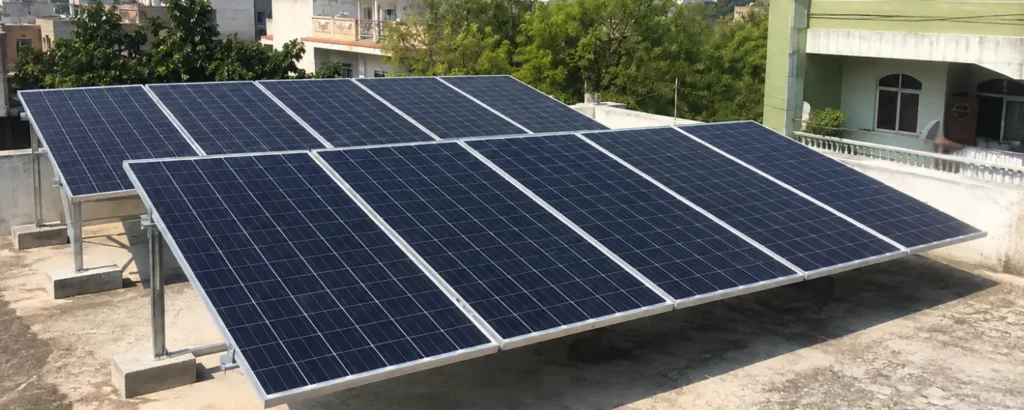
The best solar panels for rooftop use in India are Mono PERC, N-TOPCon, and Bifacial modules. MONO PERC is more suitable for large roofs that have a budget to accommodate it. The N-TOPCon type is ideal for homes that have little space but require high power output. The bifacial solar panels harness solar energy from both sides when used around reflective surfaces. However, the final choice depends on your roof size and budget.
Key Takeaways
- Mono PERC, N-TOPCon, and Bifacial are the leading rooftop solar panel types in India.
- The N-TOPCon panels surpass an efficiency of 22%, perfect for limited roof space.
- The average size of a panel is about 5.5 feet long and 3 feet wide.
- An average Indian household requires a 2kW to 5kW rooftop solar system.
- A typical 3BHK house in India needs a 3-5 kW rooftop solar system.
- Rooftop solar installation can save 30%-40% on your electricity bills every year.
- The government offers subsidies of up to 30% of the benchmark price, which is Rs 20,000 per kWp.
- One should always verify the BIS, IEC, and ALMM certification of any panel before purchasing it.
Why Does Rooftop Solar Panel Technology Matter?
Selecting the most suitable solar panels to place on your rooftop will determine how much money you save for the next 25 years. The efficiency level determines the number of panels that your rooftop can accommodate. Also, the degradation level determines the amount of energy loss each year.
What Types of Rooftop Solar Panels Are Available in India?
There are three types of rooftop solar panels for homes in India. Every panel is meant for a distinct budget and roof situation.
1) Monocrystalline Panels: Composed of a single silicon crystal and have high efficiency and a sleek finish.
2) Polycrystalline Panels: Formed by combining several silicon fragments and are relatively cheaper and less efficient than the monocrystalline panels.
3) Thin-film Panels: Light and flexible, generally used in industrial rooftops instead of residential ones.
The renewable energy department of Delhi states that polycrystalline panels remain more preferred and economical, but monocrystalline is still more efficient. However, today, most of the residents choose monocrystalline solar panels for residential purposes.
Which Solar Panel Technology Gives the Best Efficiency?
Modern technology has progressed beyond simple monocrystalline panels. There are three big names in the residential market space: Mono PERC, TOPCon, and Bifacial.
|
Technology |
Efficiency |
Degradation Rate |
Ideal For |
|
Mono PERC |
19% to 22% |
0.3% to 0.5% |
Budget rooftops with ample space |
|
TOPCon (N-Type) |
Above 22% |
0.3% to 0.4% |
Limited roof space, hot climates |
|
Bifacial |
Up to 30% more output than monofacial |
Varies by panel type |
Reflective or elevated rooftops |
|
TOPCon Bifacial |
Above 24% |
0.3% to 0.4% per side |
High energy demand, small roofs |
The TOPCon Bifacial panels are currently the most productive panels for compact rooftops in urban cities. The Mono PERC is still an excellent choice if your rooftop has enough space. We manufacture N-Type TOPCon Bifacial Solar modules designed specifically for maximum output. Additionally, the company’s Mono PERC Half-Cut solar panels work well for cost-effective rooftop solar projects in India.
What Panel Size Is Right for Your Rooftop?
The size of the panels will be determined by how much roof area you have and how much electricity you require. A standard residential solar panel has dimensions of about 5.5 feet in length and over 3 feet in width. Speaking of commercial panels, they typically measure around 78 by 39 inches.
The following are the approximate sizing guidelines for Indian households:
- A 1kW system is sufficient for 20 LED lights of 9 watts each.
- The average Indian household requires 2 to 5 kW of rooftop capacity.
- Bigger families that use air conditioners and other appliances require a high-capacity system.
- Ensure you conduct a site survey before finalising the system capacity.
Another important factor is roof configuration. Ventilation systems, water tanks, and shade areas eat up available space very quickly. An experienced installer will always check your available rooftop area first.
Which Is the Best Solar Panel Company in India?
The choice of the right solar panel company in India is equally important as choosing the best solar panels for rooftop. Choose a solar manufacturing company in India that is duly certified and has a robust service network.
Since 1997, Intersolar Systems has been manufacturing solar products, designing, assembling, and installing their products in-house. The company’s rooftop solar products are:
1) N-Type TOPCon Bifacial Solar Modules for efficient performance in limited space.
2) Mono PERC Solar Panels: These panels are designed for residential applications and offer high reliability and economic effectiveness.
3) BIPV Solar Modules used as an alternative to conventional roof or wall material.
4) Bi-Facial Solar Modules that can withstand hail and rough weather conditions.
How Much Can You Save With Rooftop Solar Panels for Home?
In India, correctly sized residential rooftop solar systems have the potential to lower the cost of energy consumption by 70% to 90%, and sometimes even bring it to almost zero under the scheme of net metering. The Council on Energy, Environment and Water (CEEW) pan-India survey indicates an average of 71% bill savings among those who have adopted solar power systems. Also, the government encourages adoption of solar energy through financial aid (subsidies like PM Surya Ghar Muft Bijli Yojana)
|
Industrial Pro Tip: Most rooftop solar panels will operate for 25 years and more with little maintenance. Regular dusting and periodic cleaning will ensure consistent performance throughout the panel’s lifespan. |
Conclusion
The best solar panels for rooftop installation are those that incorporate the correct technology, sizing, and a reliable manufacturer. Regardless of whether you choose Mono PERC, TOPCon, or Bifacial, have a site assessment done first. Interested in making the switch to rooftop solar? Get a free quotation today and reduce your monthly electricity bills.
FAQs
- Which solar panel is best for rooftops?
N-Type TOPCon Bifacial panels currently have the highest rooftop efficiency, with over 24% efficiency. Mono PERC is still the budget winner for big roofs. It all comes down to your roof size, budget, and the climate in your area. - Do rooftop solar panels work during cloudy or rainy weather?
Yes, solar panels can produce electricity even during cloudy weather, but production is significantly reduced. PV cells operate based on sunlight and not on heat; therefore, cool cloudy days will not affect their production. - How long do rooftop solar panels last?
A good-quality rooftop PV module lasts for 25+ years with maintenance. The performance warranty is usually provided by the manufacturers, while the annual degradation stays less than 0.5%.