
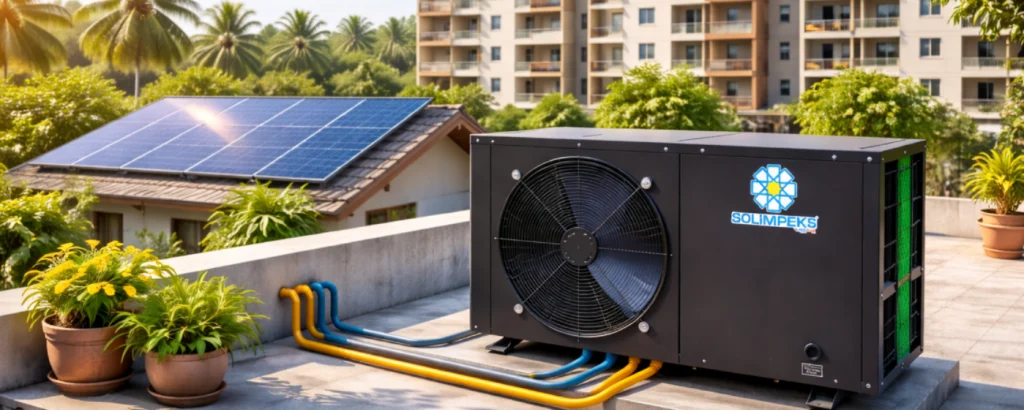
The energy costs build up quietly. An extra hot shower a day. Increased cooling in the longer summers. A growing number of laundry cycles that seem to multiply on their own. Throw in a price increase or two, and the monthly sum begins to look strange.
This is why many homeowners are now thinking twice about the way they heat water and manage their indoor climate. Not because they want to go “green” overnight, but because they want a solution that doesn’t feel as costly to operate every year.
This is where solar-based solutions enter the picture. A Solar Heat Pump relies on electricity, often supported by rooftop solar, to move heat rather than produce it. This guide will walk you through the types of heat pumps, how it works, what goes into them, and how to determine whether they will work for your house.
What Is a Solar Heat Pump?
A Solar Heat Pump is a type of heating system that relies on electricity, which can be generated from solar panels, to extract heat from the surrounding atmosphere and use it for hot water or space heating. The important point to note is this: it does not produce heat like a geyser but transfers it from one place to another place.
How It Works in a Typical Domestic Scenario
The Solar Heat Pump extracts low-temperature heat from the outside atmosphere (or water/ground sources), increases the temperature by compression, and then transfers it where it is needed. The solar panels are useful in this regard because they can be used to power the electricity-based process, which means that the house will consume less electricity from the mains.
How a Solar Heat Pump Works: Step-by-Step Process
It is easier to understand a solar heat pump if you consider it a loop rather than a single process of heating.
- The first process of a solar heat pump involves the absorption of heat from the surroundings. This heat is normally from the outside air.
- This heat is absorbed at the evaporator and converted into a refrigerant. The refrigerant has high heat-carrying capacity; that is why it is used in this process.
- The next process involves the compressor. This is where electricity is applied. The compressor raises the pressure, which in turn raises the temperature. This is where the process of upgrading low-grade heat to useful heat takes place.
- Then follows the hot refrigerant passing through the condenser. In this stage, the hot refrigerant gives off heat to water (for hot water) or a building system (for space heating). The water is then stored in an insulated tank or distributed where needed.
- The refrigerant, now cooled, then passes through the expansion valve. This reduces the pressure of the refrigerant and readies it for another heating cycle.
One thing to notice here is that the solar panels are not directly heating the water in this process. Solar energy is used to power the compressor and control systems. That is why a solar heat pump continues to operate even on cloudy days. It only relies more on grid power when solar power is low.
Types of Heat Pumps for Residential Use
There are different types of heat pumps, and the choice of which one to use depends on the residential property, the climate, and the desired comfort level.
Air Source Heat Pumps
Air-source heat pumps are the most popular choice for residential properties. They harness heat from outside air and are preferred because they are easier to install and maintain compared to other sources.
Water Source Heat Pumps
Water-source heat pumps can be considered if the location has access to groundwater or a water body. They are known to be stable but need site conditions, approvals, and planning that may not be suitable for all properties.
Hybrid Systems
Hybrid systems are a combination of a solar heat pump and an auxiliary heater, including electric or gas backup. This configuration may be beneficial in areas with rapidly varying demand patterns throughout the year or where hot water demand peaks suddenly.
For typical residential use, the air-source residential heat pump is the most viable point of entry. Larger residences might consider scaled solutions based on commercial heat pumps, but typical residences do not require commercial-scale solutions.
Solar Heat Pump vs Solar Water Heater
A solar water heater is a system that heats water using collectors and the energy from the sun. It is a simple system that works well for hot water requirements. However, it is only used for hot water requirements.
A solar heat pump is a more versatile system. It can provide functionality for hot water requirements as well as space heating. Some solar heat pump systems can even provide functionality for cooling, depending on the design of the system.
The next difference between the two systems is that solar water heaters work on the principle of using the sun for direct heating. Solar heat pumps work on the principle of using heat transfer and electricity.
For residential purposes with simple hot water requirements, solar water heaters may be sufficient. For those seeking to lower electricity consumption in general comfort requirements, solar heat pumps would provide greater flexibility.
Advantages of Using a Solar Heat Pump in the Home
Here are the benefits of using a solar heat pump for home:
- The first advantage is the lower electricity bill in the long run. Because the system is a heat transfer mechanism and not a heat producer, it consumes less electricity than conventional electric heating for the same purpose.
- The temperature level in the home is also more stable. Instead of hot bursts of heating and frequent cycling, the system provides a more stable level of output. Many people find this preferable because it is less stop-start in operation.
- Another advantage is tariff protection. Electricity tariffs tend to increase over the years. The solar heat pump does not prevent this, but it does mitigate the home’s vulnerability to rising tariffs.
- There is also an environmental benefit. The less the grid is used, the less the indirect emissions, particularly if solar panels are involved in the system.
- The resale value may also be affected. Homebuyers are increasingly interested in the long-term operating costs of a property, apart from interior and floor space designs.
Final Thoughts
A Solar Heat Pump is not a quick fix for free energy. It is a more intelligent way to consume electricity, since it transfers heat rather than generating it from scratch. For residential properties with daily hot water requirements, the cost savings will manifest in the form of reduced electricity usage, rather than a sudden, drastic cut in electricity bills.
For homeowners already planning rooftop solar, a heat pump often fits naturally into that plan. It uses solar generation to run a system that is already efficient by design. The result is a setup that feels calmer to live with, because comfort stays steady and the running costs stop climbing as sharply.