
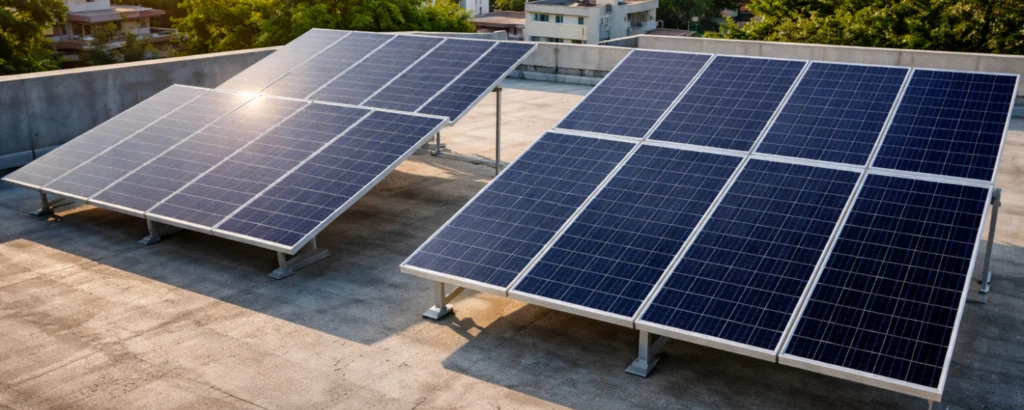
Investing in solar pv panels is an important decision that requires specific strategic planning to install the best solar system that suits our budget, space, and requirements.
The most common choices for solar panels are the monofacial solar panels or the bifacial solar panels. Both technologies have their pros and cons, and to pick one, you need to assess carefully the initial investment, long-term ROI, site conditions, including rooftop space, availability of sunlight, maintenance costs, and more.
In this blog, we will help you understand the differences between the popular technologies and which one is best for you based on your budget and needs.
What are the Bifacial Solar Panels and Monofacial Solar Panels?
The basic difference between a bifacial and a monofacial solar panel is the collection of the sun’s energy. As the name suggests, the bifacial solar panel collects energy from both sides. Specifically, the front of the panel collects the direct energy from the sun, while the second side collects the reflected energy from the roof or the surroundings.
A monofacial solar PV panel uses only one active surface, that facing the sun. This system has been powering solar PV installed on roofs for years because it is simple, effective, and easy to plan.
Today, both technologies are available in advanced forms like the Mono PERC half-cut solar panel and the N-Type TOPCon bifacial solar panel. The choice is no longer about the technology being modern. The choice is about the technology that is possible in the rooftop environment.
How Rooftop Conditions Affect Solar Panel Performance
Rooftop space, unlike open field space, comes with certain constraints that can influence how a solar panel’s performance changes over time.
Each rooftop system has to work around:
- Limited roof area and fixed orientations
- Shadows of tanks, lift rooms, parapet walls, and neighboring buildings
- Roof surface colour and texture, which influence light reflection
- Mounting height, which regulates air flow and exposure
These factors are important as a rooftop system works with efficiency within boundaries. A panel that gives high efficiency in a system installed in the ground might not achieve the same efficiency as one installed at a point that has obstructions, such as concrete roofs.
Understanding such circumstances allows you to avoid choosing a technology that appears good on paper but is poor in execution.
How Monofacial Solar Panels Perform on Rooftops
Monofacial panels align well with typical rooftops. Since they depend only on sunlight from the front, their behavior is much easier to estimate at design.
Basically, monofacial panels on residential and small commercial rooftops usually:
- Are consistent in performance with even low mounting clearance.
- Handle partial shading in a more predictable way by planning the layout well.
- Need simpler mounting structures
- Are easier to clean and inspect
Mono PERC half-cut solar panels are especially common due to better heat management and reduced losses caused by shading. These traits suit rooftops where temperature and dust are constant challenges.
These are usually more reliable for day-to-day output in buildings with compact roofs or irregular layouts, even if their headline efficiency is lower.
How Bifacial Solar Panels Perform on Rooftops
Bifacial solar panels can add value on rooftops, but only when the setup allows them to function as intended. The rear of the panel produces power due to reflections, and this influences installations more than usual.
Bifacial panels work best on rooftops under the following circumstances:
- The panels are high enough to expose the rear surface
- The roof has a light or reflective finish
- Shading is minimal for the majority of the day
- The structural design can accommodate mounting systems that are heavier
In many residential buildings, achieving these conditions is difficult. As a result, the additional energy gain may be limited. Larger commercial rooftops, with open layouts and engineered designs, tend to benefit more clearly from bifacial systems.
This difference explains why bifacial technology is more common in industrial and utility-scale projects than in homes.
Installation and Design Considerations
Installation quality can make or break rooftop performance, especially when comparing bifacial and monofacial systems.
Important design factors include:
- Mounting height and structural strength
- Wind load calculations and roof safety standards
- Cable routing and inverter placement
- Waterproofing around the anchors and supports
Bifacial systems demand tighter engineering because rear-side exposure must remain unobstructed. If installation is rushed or simplified, the expected gains disappear quickly.
Monofacial systems are more forgiving. This is one reason many EPC teams prefer them for rooftops with space or structural limitations.
Energy Yield Comparison in Indian Rooftop Conditions
There are challenges that have been identified on Indian roofs, such as high ambient temperatures, dust, and different seasons.
Monofacial panels tend to perform well in these conditions as they do not rely on reflected light for energy production. Bifacial modules often perform poorly when dust covers the roof or when dark surfaces absorb instead of reflecting the sunlight.
Similarly, airflow also contributes. Rooftops often restrict ventilation, which affects both technologies, but bifacial systems require additional spacing to maintain rear-side efficiency.
In real installations, the difference in energy yield between the two technologies is often smaller than expected.
Which Technology Makes More Sense for Your Rooftop?
The choice of solar PV panels is ultimately dependent onhow well the technology fits the site.
Situations where monofacial panels are more beneficial:
- Roof space is limited
- Shading cannot be completely avoided
- Budget control and predictable returns are important
- The system is residential or small commercial
Bifacial panels can be considered in the following cases:
- The rooftop is spacious and robust
- Reflective Surfaces may be introduced
- This project is commercial or industrial
- The installation height could be optimised
There is no universal solar PV panel winner. The rooftop itself determines which technology performs better.
Bottom Line
Bifacial solar panels and monofacial solar panels are both important for rooftop solar use, but they are used in different conditions. Rooftop solar panels are not for maximum efficiency but for performance within a certain limit.
However, for the vast majority of residential and even some commercial properties, monofacial modules prove to be the better option. Bifacial solutions add value to rooftops that have been architected to support the technology.
A successful rooftop solar project starts with a realistic assessment of space, structure, and usage, and then with technology that performs seamlessly and quietly in the background.
Frequently Asked Questions
1. Are bifacial solar panels better than monofacial panels for rooftops?
Not in every case. Bifacial panels need specific conditions to perform well. On many rooftops, monofacial panels deliver more predictable results.
2. Do monofacial panels work better in shaded areas?
They tend to behave more consistently under partial shading, especially when paired with proper layout design and half-cut cell technology.
3. How much extra energy can bifacial panels generate on rooftops?
The increase varies widely. On standard rooftops, gains are often modest and depend on reflectivity, height, and shading levels.
4. Does roof colour affect bifacial panel performance?
Yes. Light or reflective roofs improve rear-side generation, while dark or dusty surfaces reduce the benefit significantly.
5. How important is the solar panel manufacturer in overall performance?
Very important. Build quality, heat tolerance, warranties, and service support from experienced manufacturers in India directly affect system lifespan and output.