
India’s agriculture sector feeds over a billion people, yet the farmers who make that possible continue to face one of their most persistent challenges. Their high dependence on reliable, affordable water for irrigation. With over 60 per cent of the rural population dependent on farming for their livelihood, the stakes could not be higher.
Erratic monsoons, depleting groundwater, skyrocketing diesel costs, and unreliable grid electricity have long undermined the productivity of millions of small and marginal farmers. The solar irrigation system for farmers is rapidly emerging as the most practical and sustainable answer to this crisis.
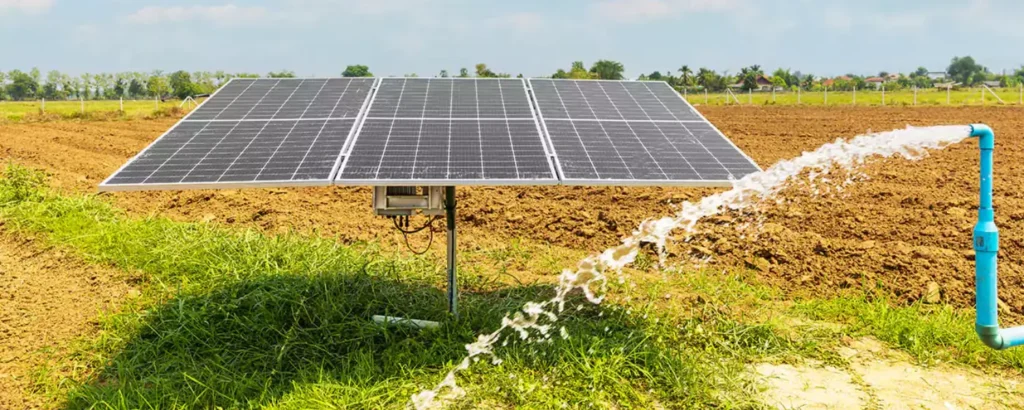
Solar pumps for farm irrigation utilise the energy from the sun to pump water directly from wells, rivers, and canals to fields. With leading Solar Panel Manufacturer India companies and government schemes such as PM-KUSUM driving adoption, solar-powered irrigation is transforming rural agriculture into a profitable industry.
Key Benefits of Solar Irrigation Systems for Indian Farmers
Significant Reduction in Operational Costs
One of the most significant benefits of solar irrigation system adoption is the sharp reduction in running expenses. While diesel pumps have high operational costs because of fluctuating fuel prices and maintenance costs, solar pumps for farms contrast.
Once installed, solar pumps require minimal day-to-day expenditure because their energy source “SUN” is free. Most farmers recover their initial investments within three to five years by saving on fuel and electricity. For the remaining 15 to 20 years of its operational life, the system provides free irrigation.
Energy Independence and Reliable Water Supply
Indian farmers in several rural areas receive grid electricity only during nighttime for a few hours, which can become an inefficient nocturnal irrigation. This problem is resolved by the solar pump that allows the generation of electricity during daylight hours.
Farmers do not have to wait for a conventional grid supply to work around the unpredictable power cuts. Timely daytime irrigation results in healthier crops and better yields.
Support for Multiple Cropping Patterns
When there is an efficient solar irrigation system available to the farmers, they need not be bound to grow only one type of crop. They can grow different types of crops such as vegetables, pulses, and oilseeds throughout the year due to the consistent availability of water. Such practice leads to diversification of income and lowers the risks associated with the failure of crops.
Environmental Sustainability and Carbon Footprint Reduction
Diesel pumps are infamous for emitting greenhouse gases and contributing to rural air pollution. In contrast, solar PV panels produce zero emissions during operation. This widespread adoption of solar pumps for farm irrigation reduces the carbon footprint in the agriculture sector.
Additionally, when paired with efficient irrigation methods such as drip or sprinkler systems, solar irrigation protects India’s fast-depleting groundwater reserves by minimising water wastage.
Additional Income Through Surplus Power Generation
In programs like PM-KUSUM Component A, farmers who set up solar power generation facilities on idle land through grid connectivity have the option of selling any excess power generated to DISCOMs. The dual advantage of being provided with free irrigation while having another source of income creates a paradigm shift in small-scale farming.
Low Maintenance and Long Operational Life
Solar PV panels are built to last for 25 to 30 years. In fact, high-quality panels from a trusted Solar Panel Manufacturer in India run smoothly with minimal maintenance services.
The key advantage is that there are no moving parts in the panels, no engine servicing to arrange, or no fuel supply chains to manage. These features make the solar power irrigation system valuable, especially in remote rural areas, where specialised mechanics are difficult to access.
Government Support: PM-KUSUM and Its Components
The Indian government has backed the solar irrigation system for farmers through this flagship programme. The highlights of this programme are as follows:
- The Pradhan Mantri Kisan Urja Suraksha evam Utthaan Mahabhiyan (PM-KUSUM) was launched in the year 2019. It was launched by the Ministry of New and Renewable Energy (MNRE), whose objective is to “de-dieselise” the farm sector by adding 34,800 MW of solar power, with the support of ₹34,422 crore from the central government.
| Financial Support | Details |
| Total Subsidy | Farmers receive up to 60% subsidy on solar pumps, with 30% from the central government and the remaining 30% borne by the State government. |
| Farmer Contribution | Farmers are required to pay only 10% of the total upfront cost. |
| Bank Loan Support | The remaining 30% of the support is covered through bank loans with lower interest rates because it falls under “Priority Sector Lending.” |
| Special Regions | In some chosen regions, like the North-Eastern and hilly states, the Central Government aids with a higher subsidy of 50%. |
- This scheme has shown tremendous progress so far. In the fiscal year 2024-25, there was a 4.2 times increase by 4.4 lakh pump installations in Component B from the last fiscal year. In fact, the overall number of solar pumps installed under the PM-KUSUM scheme has crossed the 10 lakh mark. For the year 2025-26, the Union Budget has allocated a substantial ₹2,600 crore for further solar expansion in farming communities.
This scheme has the following three components:
Component A
Individual farmers, groups of farmers, cooperatives, Panchayats, and Farmer Producer Organisations (FPOs) can install small solar plants between 500 kW and 2 MW capacity. They can either set up the plant themselves or lease their land to a developer. This allows them to have a steady income by selling the generated electricity to DISCOMs.
Component B
14 lakh standalone solar pumps and off-grid solar agriculture pumps installation have replaced diesel-based pumps with no reliable electricity supply. Under this component, the farmers receive subsidiary help from both the Central and the State Governments. The remaining help can be availed through bank loans to reduce their upfront cost to just 10%.
Note: States like Maharashtra and Madhya Pradesh support their farmers with a combined subsidy of 90% to 95%. It means that they just pay as little as 5% to 10%.
Component C
Solarisation of 35 Lakh existing grid-connected agriculture pumps reduces their high dependence on electricity from DISCOMs. Under this component, farmers can install PV systems to double the existing pump capacity.
To conclude, PM-KUSUM solar pump yojana promotes solar adoption by the farmers without letting them take any financial burden.
Conclusion
The benefits of solar irrigation system adoption go beyond the simple cost savings. For Indian farmers, solar-powered irrigation is a means for energy independence, water security, and improved yields.
In the present situation, where high-efficiency Solar PV panels are more affordable than ever before. With significant government incentives like PM-KUSUM and the number of professional Solar Panel manufacturers in India, it is the best time for Indian farmers to opt for solar power.
FAQs
Q1) Who is eligible for the Pradhan Mantri Solar Scheme (PM-KUSUM)?
PM-KUSUM covers a full spectrum of India’s agricultural community. The eligible categories to apply under the scheme are:
– Individual farmers with available cultivable land and water resources.
– A group of farmers applying together.
– Cooperatives and Panchayats for larger solar power pump projects.
– Farmer Producer Organisations (FPOs) and Water User Associations (WUAs).
– Primary Agriculture Credit Societies and community-based irrigation systems.
Q2) What is the PM-KUSUM Scheme in 2026?
PM-KUSUM is the Government of India’s flagship scheme for bringing solar energy to the agricultural industry. Launched by the Ministry of New and Renewable Energy (MNRE) in the year 2019, it aims to “de-dieselise” the farm sector. Its other core objectives include the provision of daytime, reliable power for irrigation and creating additional income opportunities for Indian farmers.
The current phase of PM-KUSUM has been extended to March 2026, and Phase II is expected to be launched after that. New 2026 policies under the scheme allow higher-capacity pumps of up to 15 HP in some states.
Q3) What is the Cost of a 5 HP Solar Pump under the PM-KUSUM Yojana?
The total cost of a 5 HP solar pump system before subsidy ranges from ₹2 Lakh to ₹3.5 Lakh. However, the exact figure depends on the type of system and pump or the state-specific benchmark prices set by MNRE.
Under PM-KUSUM’s standard subsidy structure, for a total cost of ₹3 lakh, the cumulative subsidy of 60% provided by the centre and states leaves the farmer responsible for just ₹1.2 lakh. In addition to the subsidy, the bank loan facility can cover another ₹90,000, leaving the farmer liable for only ₹30,000 initially.